


Background
SwRI recently created a software framework via a regular internal research and development project, Coordinated Motion (COMOT), that enables infrastructure-free coordinated motion between a mobile base with omnidirectional steering and an onboard robotic manipulator which can independently control longitudinal, lateral, and rotational motion. Many existing systems could benefit from COMOT’s capabilities but use Ackermann or differential steering. These mobile base steering methodologies do not permit lateral motion and tightly couple longitudinal and rotational motion. This presented a significant obstacle for the motion planners used in the COMOT framework and required further study.
Approach
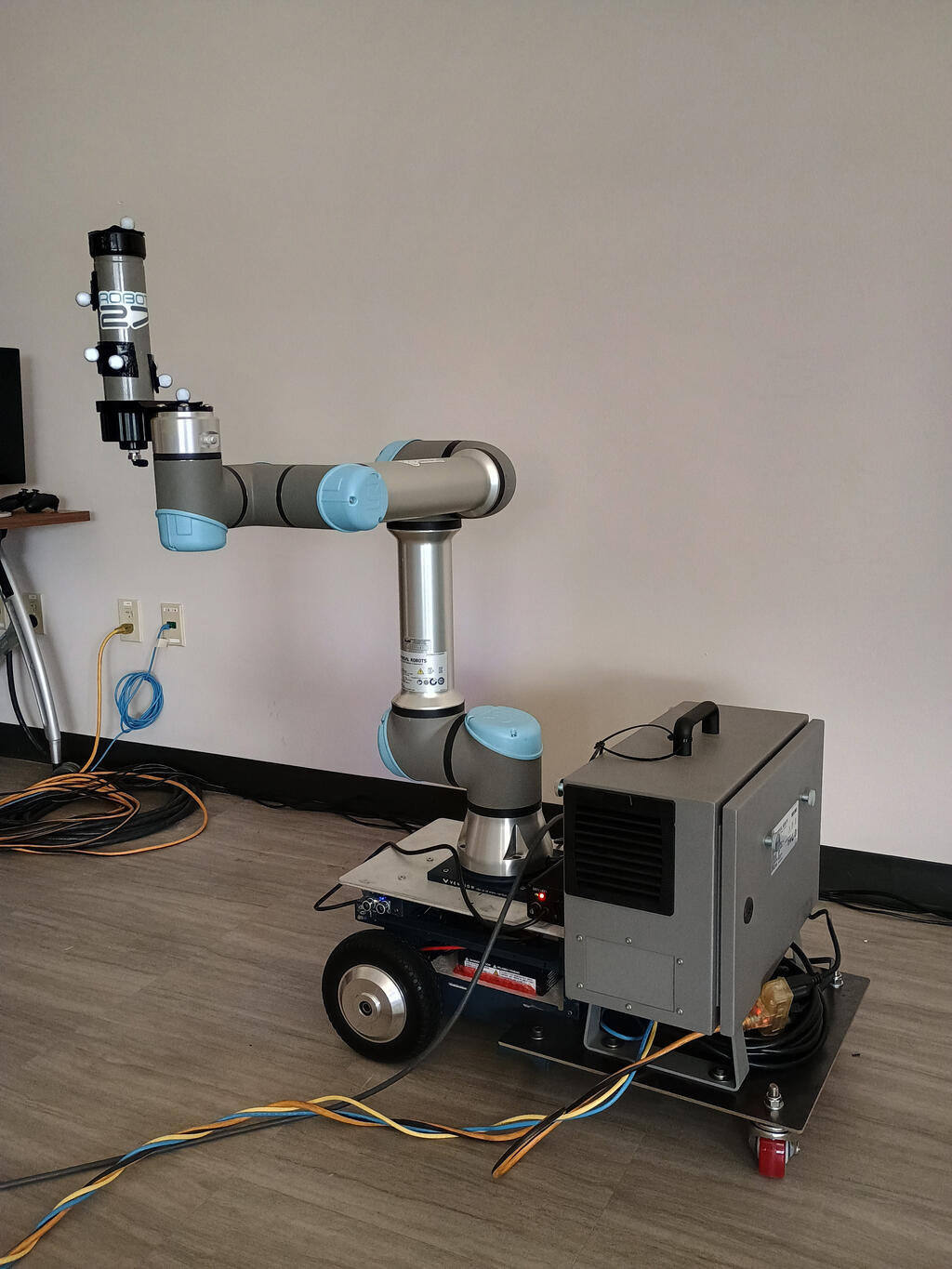
Figure 1: Industrial manipulator mounted on mobile base with differential steering.
This project investigated whether the COMOT framework can be extended to mobile bases with Ackermann steering modalities. We developed a mathematical model for Ackermann steering that models the constraints as a check or cost between successive waypoints and models the system’s kinematics in a holonomic manner. We successfully implemented this model into one of COMOT’s two motion planners, while numerical issues caused persistent planning failure in the other. We adapted the execution pipelines to use an available Ackermann-based mobile platform and verified successful open-loop execution of example trajectories. Because numerical issues in the particular constraint implementation prevented us from performing the dynamic re-planning necessary for coordinated motion, we were unable to quantify the whole-system performance.
Accomplishments
We were able to complete most of the mathematical modelling and software development needed for integrating Ackermann steering into the COMOT framework. All but one system component has been verified and demonstrated to work. Several potential clients have shown strong interest in deploying COMOT’s capabilities on their Ackermann-based systems and this project has shown that to be feasible with an improved software implementation of the constraint model.