


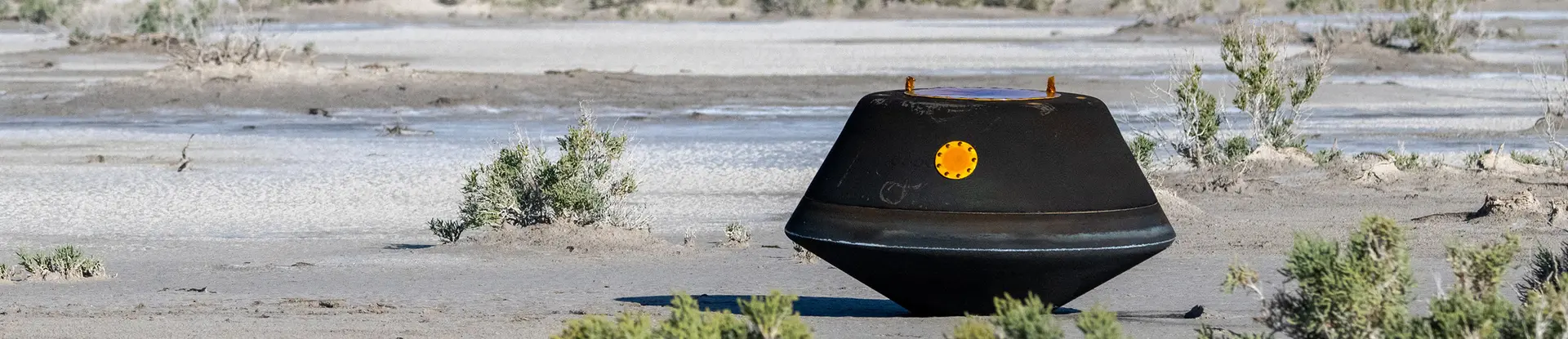
NASA’s Origins, Spectral Interpretation, Resource Identification and Security – Regolith Explorer (OSIRIS-REx) mission returned to Earth in September 2023 to drop off a sample of rocks and dust from the near-Earth, carbonaceous asteroid Bennu. The first U.S. mission to collect untouched, pristine material from an asteroid is giving scientists a glimpse into the early solar system and insight into the origins of life on Earth. We featured OSIRIS-REx before collection day in 2020. Now, we revisit the mission with an update on sample collection, the delivery of the “time capsule” to Earth and the research uncovering the secrets of the solar system.
Listen now as SwRI planetary geologist and OSIRIS-REx co-investigator and instrument scientist Dr. Vicky Hamilton discusses mission milestones, the research team’s surprise findings and what OSIRIS-REx is uncovering about the ingredients of life. Plus, Hamilton briefs us on the latest developments of NASA’s Lucy mission.
Visit Planetary Science to learn more about SwRI’s investigations into the origin, evolution and current state of solar system objects.
Transcript
Below is a transcript of the episode, modified for clarity.
Lisa Peña: NASA's OSIRIS-REx mission successfully delivered a pristine time capsule from the earliest days of our solar system. The mission collected rocks and dust from the near-Earth asteroid Bennu. What the sample reveals about the origins of life on Earth and the potential for life elsewhere in the solar system, that's next on this episode of Technology Today.
[MUSIC PLAYING]
We live with technology, science, engineering, and the results of innovative research every day. Now, let's understand it better. You're listening to the Technology Today Podcast presented by Southwest Research Institute. From deep sea to deep space, we develop solutions to benefit humankind. Transcript and photos for this episode and all episodes are available at podcast.swri.org. Share the podcast and hit that subscribe button on your favorite podcast platform.
Hello, and welcome to Technology Today. I'm Lisa Peña. NASA's OSIRIS-REx is the first US mission to collect a sample from an asteroid. The spacecraft launched in September 2016. In October 2020, it collected a sample of rocks and dust from the surface of the near-Earth asteroid Bennu and delivered that sample to Earth in September 2023. Since then, scientists have been analyzing the rocks and dust, looking for the ingredients of life.
SwRI Planetary Geologist and OSIRIS-REx Instrument Scientist and Mission Co-Investigator Dr. Vicky Hamilton was a podcast guest right before the sample collection in 2020. She is back with an exciting update on what the mission uncovered. Vicky joins us from the SwRI Solar System Science and Exploration office in Boulder, Colorado. It's great to welcome you back, Vicky.
Image
NASA/Keegan Barber
NASA’s Origins, Spectral Interpretation, Resource Identification and Security – Regolith Explorer (OSIRIS-REx) capsule touched down in the desert at the Department of Defense Utah Test and Training Range on September 24, 2023. The capsule contained rocks and dust collected from the near-Earth, carbonaceous asteroid Bennu collected in October 2020. Learn more about the mission on the NASA OSIRIS-REx overview page.
Vicky Hamilton: Thank you. It's great to get to talk about this part of the mission.
LP: I am eager to discuss the findings of the mission, what the OSIRIS-REx team discovered in that asteroid sample, that leftover debris from the formation of our solar system. But first, let's start with a recap of the OSIRIS-REx mission. What was the goal of the mission?
VH: The mission actually had a number of goals, but the first and foremost was to collect a sample from an asteroid, specifically what we call a carbonaceous asteroid, and bring it back to Earth. But we also had goals of making sure that we mapped that asteroid, took lots and lots of photographs to understand its geology. And we also made remote measurements of the chemistry and mineralogy of the surface of the asteroid so that we would have context for the sample when we brought it back home.
LP: Why did the mission in target Bennu specifically?
VH: Asteroids come in a bunch of different flavors. They form in different environments, and they're made of different things. Bennu is interesting because it is what we call a very primitive object. It was formed very early in solar system history and underwent very, very little subsequent geologic activity. There has been aqueous interactions, water interactions with the rocks of this asteroid and others like it.
So that makes it interesting to us, because we know water is an essential ingredient of life. And we know this class of asteroids, carbonaceous asteroids have organic compounds. And so we really wanted to find one of these very, very early rocks and try to understand what was going on with the solar system chemistry in those earliest eons.
LP: OK, so Bennu was the perfect fit for this mission. And on October 20, 2020, OSIRIS-REx collected 4.29 ounces of rocks and dust from the surface of Bennu. Now, we spoke to you right before this collection event. So how did that unfold? What was most memorable about collection day?
VH: Collection day for the science team is it's a little hard to describe because you're not watching things happen or experiencing things happening in real time. We didn't have images as it was happening. All we had to do was sit and wait for the spacecraft to do what it was told to do, and then back away from the asteroid, and then communicate to us that it was OK and had done what it was intended to do.
It then took many hours for the data to come back with the pictures of the sampling event. But that in and of itself was the most amazing thing, because we really did have this unbelievable view of the surface of this asteroid from just a few feet away.
And when we put those pictures into a sequence and made a little movie, it was astonishing just to see the spacecraft coming down, touching the asteroid, the material being blown out, and seeing the spacecraft then back away from that. Just it was after the fact, but it was still almost like we were there, and it was just amazing.
LP: Yeah. So I'm thinking all those years of planning and to see that finally come to fruition. We are here on the asteroid, collecting this sample. There had to have been a lot of really great memories made that day.
VH: Absolutely. It was a really tough time. This was happening during the COVID-19 pandemic, so we couldn't all be together for this event the way we normally would have been. But it was after all those years of hard work to get to that point, to see it execute so flawlessly at a time when we were all looking for good news was just overwhelming.
LP: OK. And then the spacecraft headed back toward Earth with that sample arriving on September 24, 2023. So describe the arrival. Where did it touch down, and how did the sample arrive to Earth uncontaminated?
NASA’s Goddard Space Flight Center
A compilation of spacecraft, airplane and ground camera footage shows the capsule’s return to Earth.
VH: For me, I think there are so many things that are memorable about that day. Unlike many events in my life, I can picture most of that day, even though I wasn't on site for the sample return.
But basically what happened was the spacecraft flew towards the Earth. It released a capsule. And then the spacecraft diverts away from the Earth, and the capsule comes in, very much like we're accustomed now, to seeing we saw it with Apollo, but now we're seeing it with today's astronaut return systems. This capsule comes down through the atmosphere.
And in our case, instead of landing in the ocean, we landed out in the middle of the desert in Utah. And so we had the ability to see from many, many different perspectives the capsule entering the atmosphere and landing on the surface. And then when it landed, it landed perfectly upright. Like, it was just it could not have been more perfect. And there was no apparent damage, no nothing. It just looked flawless. And so that was an exciting moment.
And then of course, the first couple of people, including the mission principal investigator, got to go out and look at it right out there in the desert. But we don't open it up out there. They very carefully pick up the capsule and carry it into a secure facility there at the Utah Test and Training Range.
And then within 24 hours, that capsule was shipped to Johnson Space Center in Houston. And so that whole first day was about all of those activities. And I just remember being riveted to my TV, watching that capsule get moved and secured and ready for transport.
LP: What was the process to get it back to the clean room?
VH: So once the capsule was loaded into an airplane and flown to Johnson Space Center in Houston, the capsule was very carefully carried into the building, the curation facility there. And it was literally almost hand-carried into this room that had been specially designed over the previous several years to hold the capsule.
And then there was a multi-step process from there to first open the capsule and then continue to remove piece by piece, very carefully, all the parts that were around the sample before we could actually get to what we call the sampling head, where the sample actually was located.
LP: OK. So it was all hands on deck to get this sample into that clean room. Why was it incredibly important to keep that sample untouched and uncontaminated?
VH: One of the reasons that we went to this asteroid and wanted to collect a sample directly from it and bring it back and not expose it to the Earth environment is because our Earth is loaded with biology, right? We have all kinds of life in the atmosphere, in the water, the oceans, on land. And we didn't want the sample contaminated by anything here on Earth that might make it difficult for us to understand which parts of the organic chemistry from the asteroid were actually from the asteroid instead of possible contaminants.
The other reason that we want to keep it clean too is because, again, our Earth is a wonderful place for us, but it's loaded with water in the atmosphere, on us, all over the place. And water can be a great agent for modifying chemistry. So we didn't want any of our Earth water in any form to come in contact with the sample, because it would change the chemistry of the sample, and we did not want to have that happen before we could make our measurements.
LP: So back on Earth, you have this pristine sample from Bennu. Then the research begins, the payoff for a mission years in the making. So how did you examine the sample? What were you looking for?
VH: Well, so the science team is quite large, and we have people who study many, many different aspects of the sample. My particular research is infrared spectroscopy. I'm a geologist, so I'm interested in the minerals that make up the rocks and how they compare to things like meteorites that we believe came from asteroids like Bennu.
And I also because I was an instrument scientist on the mission, collecting data about the asteroid, I wanted to be able to relate the sample back to all that context data that we had collected. So I was part of a team that shared a sample that was embedded in epoxy and leveled off flat so that we could collect spectra of it.
And then that is primarily the kind of analysis that I did. I was looking to see if the infrared spectra of the sample looked like the meteorites that we think are related to it, or if it was different. And so that's really the primary thing that I was after.
NASA/Goddard/University of Arizona
The robotic arm of the OSIRIS-REx spacecraft briefly touched the surface of Bennu to collect dust and pebbles.
LP: Then the big question. What did the team find in the sample?
VH: We found all kinds of things, things we thought we'd find and things we didn't think we would find. So we found a lot of what we call volatiles. So this is things like carbon, nitrogen, ammonia. And more than we were accustomed to seeing in the meteorites that we have here on Earth. We were able to find that a lot of that formed in a very cold location or further away from the sun than the asteroid currently is in its orbit.
We found minerals that we had never seen in comparable meteorites. And so the team has just been ecstatic with what we found, what we got.
LP: So yeah, you said you found some things you thought you'd find. Others, you were surprised to find. So what was your most surprising finding?
VH: There are two that stand out in my mind. One of them is about the organic chemistry that is in the sample. Some folks may be familiar with the idea of chirality, or left or right-handedness in chemical compounds. And on Earth, almost all of our life is what we call left-handed. And we assumed that the sample we got back, that everything else out in our solar system would be like that.
Except it turns out, that's not the case. In Bennu's case, all of the amino acids that were not proteins basically were roughly equally left-handed and right-handed. And so that really changed our assumptions about the organic chemistry that is associated with life here on Earth, and that it might have been biased by something happening in the early solar system. That doesn't seem to be the case, and so we don't quite understand why yet.
Another thing that we found were phosphate minerals. And phosphates are very common on Earth. They have industrial applications. They're quite common. But they have never been detected in meteorites of the type that are, we think, related to asteroids like Bennu.
And we don't know why that is. We don't know if it's because it's rare or because that material has been removed by chemical processes, by interaction with the Earth's environment. So those are two that stand out for me.
LP: You have described Bennu as a time capsule of the early solar system. What did these findings reveal about the origin of life on Earth?
VH: The answer to that is that it's going to take time for us to fully appreciate what this sample is telling us. We are still, even a year and a half later, really just trying-- starting to get our arms around the sample and what is in it.
But even so, we have made some inferences or discoveries that tell us that maybe there was more organic material in some asteroids than we had realized before. So for example, most of the meteorites that are like asteroid Bennu don't have very much organic material in them. For example, it's very rare for them to have 5% by weight organic material. And yet, the sample from Bennu has more than 5% by weight of organic material.
So that was actually unexpected. It doesn't maybe sound like a big difference, but it tells us there was more organic material around at that time than we have realized from the meteorites that we have available to us to study.
We also were able to determine that Bennu very likely formed in the outer solar system. This is where the carbon, nitrogen, ammonia, all of those compounds were being integrated into the material that formed Bennu.
And so it's telling us something about how the delivery of those materials from the outer solar system, getting into the inner solar system where we believe then that asteroids and comets were impacting the early Earth, delivering all that chemistry to the surface of this planet. And ultimately, a miracle occurs in this box, [LAUGHS] and we pop out one day. So there's still a lot of information in there to continue to tease out about the direct link to the origin of life on Earth, but we're starting to put more of the pieces of the puzzle together with this sample.
We knew that the organic materials were in these objects, but something that we have always known is that the meteorites that we have available to study those materials have experienced they've all experienced some interaction with the Earth and been exposed to our water, our biology, and so forth. And so even though we have a pretty good idea of when a sample has been contaminated, a lot of times that contamination or the environment the sample has been in erases some of the history that was there. And so with Bennu, we've been able to keep this nice, pristine sample the way it was for the last 4.5 billion years and get a much clearer picture of what was really happening there, and helps us understand where the meteorites are missing information that we didn't realize was missing.
NASA/Goddard/CI Lab
This animation shows how OSIRIS-REx descended to Bennu’s surface, collected and stored asteroid rocks and dust and then pushed away after collection was complete.
LP: So once you understood the Bennu sample composition, how did that feel? Was that an exciting time for you? You know, what did it mean to you as a planetary geologist?
VH: It was exciting. I think everybody kind of had their ideas about, oh, what if it ends up being more like this kind of meteorite or that kind of meteorite? And people were making informed guesses about what we could end up with. But when we got the sample back and we saw what it was and that it resembled some of the rarest meteorites on Earth, I think we were all thrilled.
We were all excited. I don't think anybody cared what it turned out to be. We were always going to be excited about it. But this particular result, the particular sample we got was the best thing that could have gotten. And so we were just tremendously excited.
As a planetary geologist, my interest is less actually around the origin of life questions and more about the composition of the early solar system, the rocks and the minerals. And so for me and the type of analysis that I do and science that I do, it was just fun to get my hands on a sample, so to speak, that was just so rare and so precious, so old. To hold something in my hand and know that it was that old and had been virtually unchanged was just I keep saying words like amazing and exciting and all of that, but it was all those things.
LP: Yeah. It just doesn't seem like those adjectives are enough to hold something from the early solar system that you were never intended to see, let alone touch. [LAUGHS] And by touch, you mean probably with a glove, right?
VH: Absolutely.
[LAUGHTER]
LP: Yeah. After all that work to keep a sample pristine. So what happens now with this new information, with this new insight? How do your findings advance science?
VH: The new information is getting published in scientific journals so that not just the OSIRIS-REx team, but everybody can understand what we're finding in this sample. We're also doing a lot of comparisons to the sample brought back by a Japanese mission called Hayabusa2, which sampled an asteroid called Ryugu just before we sampled Bennu with OSIRIS-REx.
And their sample came back about a year before ours. And it turns out that the two asteroids are remarkably similar, but they are not the same. So we're doing a lot of comparisons about that. And as we do those comparisons and make more measurements on the organic chemistry and the mineralogy, we are able to develop a more complete picture of the history of these asteroids, and again, try to understand better their distribution in the solar system today and in the past.
And then one of the big consequences of this and I've mentioned this previously is that the meteorites that we have available to us are the only samples that landed on Earth, and somebody found them or saw them fall. We know that they are a biased sampling of all the stuff flying around in the solar system. And so when we have these kinds of samples, it allows us to expand our vision of what these materials are and what we can learn from them about the formation and evolution of our solar system.
LP: So with the two asteroids, the Japanese sample and our sample showing differences, is there a preliminary story there about what that could mean? Are there any guesses as to why these two near-Earth asteroids would be different?
VH: I think some of it boils down to the fact that they were not in exactly the same location at the same time, and so may have been exposed to slightly different processes. But overall, they're quite similar.
LP: After dropping off the Bennu capsule through Earth's atmosphere, the spacecraft was renamed OSIRIS-APEX and sent on a new mission. Where is the spacecraft now?
Image
NASA
The untouched Bennu sample was transported to a clean room for processing. The capsule lid was carefully opened to reveal the rocks and dust from the surface of the asteroid; material left over from the early solar system.
VH: So before I answer the question about where the spacecraft is, I want to explain what OSIRIS-APEX is. So OSIRIS-REx was the OSIRIS Regolith Explorer. OSIRIS-APEX is the APophis Explorer.
So this is an asteroid, Apophis, that is going to have an extremely close pass by the Earth in 2029. At one point in time, it was considered the most hazardous asteroid, potentially hazardous asteroid to Earth, and it may still be. But this is an opportunity for us to observe an asteroid after a very close pass with Earth and see if we can learn anything about a new kind of material, because Apophis is very different than Bennu.
LP: So where is that spacecraft now?
VH: OSIRIS-APEX is in orbit around the sun. It is working its way towards Apophis. We have to go fly around the sun several times to do that. So right now, OSIRIS-APEX is actually relatively close to the Earth and the sun. We're going to have what we call a gravity assist, where the spacecraft flies very close past the Earth and uses that to change its trajectory. And that will be happening in September. So it's actually kind of near home right now.
LP: All right. So we're going to take a minute away from OSIRIS-REx, OSIRIS-APEX, and Bennu to talk about another NASA mission that you are working on. You are an instrument scientist and co-investigator on NASA's Lucy mission, which launched in October 2021.
The mission is named for a fossilized skeleton of a human ancestor, which was named for the Beatles song "Lucy in the Sky with Diamonds." We all know that one. Lucy is the first mission to explore the Jupiter Trojan asteroids, and flybys have already started with the last scheduled for March 2033. So what can you tell us about Lucy's progress?
VH: Lucy has been a really fun mission. And what we've been doing so far is working our way towards the Jupiter system to look at what you described are called these Trojan asteroids. They're asteroids that share Jupiter's orbit.
But before we get there, we've already had the opportunity to fly past two other asteroids that are elsewhere here, closer to Earth in the solar system. And so we went to one called Dinkinesh and flew past it, and discovered that it actually had a second little asteroid associated with it. So it was what we call a binary asteroid. And we didn't expect that, so that was the first thing that happened that was really exciting.
And then earlier this year, we had a flyby of another asteroid called Donaldjohanson, which is named for the anthropologist who discovered the Lucy skeleton. And so we got a look at that asteroid too. And we've used those opportunities to test out spacecraft systems, make sure that we understand that everything is working the way it should, and refine our approach to how we're going to make our measurements when we get to the Jupiter Trojans in a year and a half, two years, or so.
LP: And how are scientists using experiences and findings from Bennu, from the OSIRIS-REx mission, to support Lucy?
Image
F. Scott Anderson
SwRI planetary geologist Dr. Vicky Hamilton investigates the composition of solar system objects. Hamilton is an OSIRIS-REx co-investigator and instrument scientist. She compared the material from Bennu to meteorites found on Earth.
VH: I think a lot of that comes from the instrumentation. Several of the instruments, or two at least two of the instruments that are on the Lucy mission are basically copies of instruments that are on OSIRIS-REx or OSIRIS-APEX. And so those of us who were involved with the development of those instruments and the operation of them at Bennu have been able to bring that experience to the Lucy mission so that we have a better sense of the environment that we're going to be in, how we collect the data to optimize data quality, and things like that.
LP: Your work is fascinating. You're rewriting the textbooks with your research and findings. What do you most enjoy about your work as a planetary geologist?
VH: Boy, that's a great question. I just love the idea that we have the technology, the ability to visit these distant places and measure what they're made out of, be able to pick up a sample, and return it to the Earth safely, and then like I mentioned earlier, be able to hold that sample and know that you're holding a piece of another solar system object. That experience is just something not very many people are fortunate to have, and it's one of the best parts of my job.
LP: I'm sure it makes you feel just makes you realize how vast the solar system is, how small we are. Yeah, really fascinating, everything you do.
OK. Well, so much incredible research unfolding through OSIRIS-REx as it changes our understanding of life on Earth and the potential for life in the solar system. If you want to learn more about OSIRIS-REx and Bennu, visit the NASA link NASA's OSIRIS-REx Mission to Asteriod Bennu on the Episode 81 web page. Thank you so much for coming back and joining us on the podcast again for this incredible update, Vicky.
VH: Thank you. Thank you for having me.
And thank you to our listeners for learning along with us today. You can hear all of our Technology Today episodes, and see photos, and complete transcripts at podcast.swri.org. Remember to share our podcast and subscribe on your favorite podcast platform.
Want to see what else we're up to? Connect with Southwest Research Institute on Facebook, Instagram, X, LinkedIn, and YouTube. Check out the Technology Today Magazine at technologytoday.swri.org. And now is a great time to become an SwRI problem solver. Visit our career page at SwRI.jobs.
Ian McKinney and Bryan Ortiz are the podcast audio engineers and editors. I am producer and host, Lisa Peña.
Thanks for listening.
[MUSIC PLAYING]
Our planetary science program focuses on solar system bodies and their atmospheres. Using observational data from space and ground-based instruments and numerical and theoretical analysis, we investigate the origin, evolution, and current state of solar system objects including Mars and Venus, Earth’s Moon, asteroids, comets, jovian Trojans and other Trans-Neptunian Objects.
How to Listen
Listen on Apple Podcasts, or via the SoundCloud media player above.