


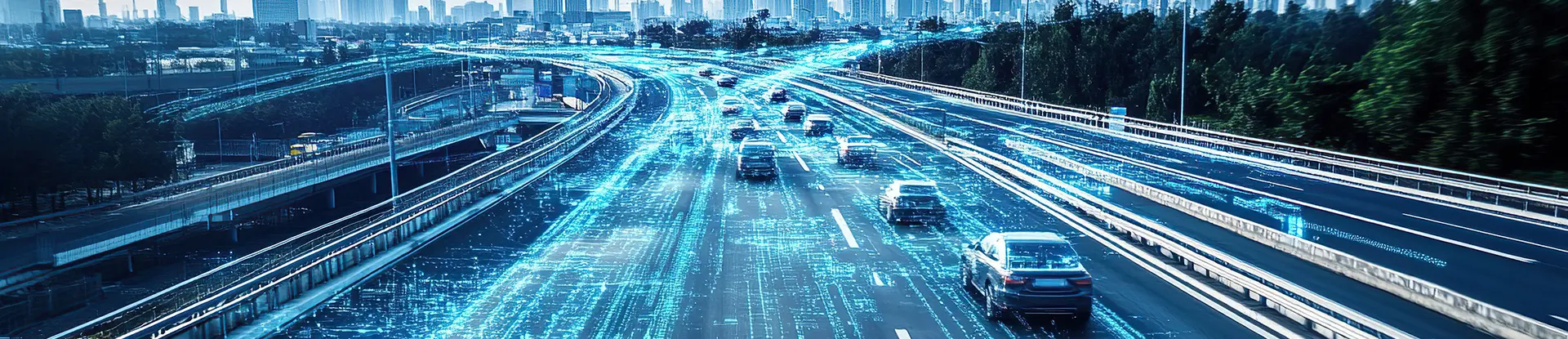
SwRI’s NEXTCAR project, funded by the Department of Energy, fuses connected and automated technologies to achieve increased vehicle efficiency. The system demonstrates up to 30% energy savings. NEXTCAR works with all vehicles — electric, hybrid or conventional — without changing the engine or hardware. This is a software solution that goes beyond mapping the best route. The NEXTCAR vehicle can “talk” to its surroundings, like other cars and infrastructure, to determine a full, energy-efficient driving plan. NEXTCAR accounts for details like how many times a driver hits the gas and pumps the brakes, a combination that often consumes more energy. After eight years of research and development, the NEXTCAR connected and automated vehicle technology is complete and ready for the next phase.
Listen now as SwRI engineer and NEXTCAR program principal investigator Stas Gankov discusses the advantages of a personal NEXTCAR driving experience, how the system collects valuable data and his call out for collaborators for the next phase.
Visit Connected Powertrain to learn more about NEXTCAR and SwRI’s connected and automated vehicle technology.
Transcript
Below is a transcript of the episode, modified for clarity.
Lisa Peña: SwRI developed a vehicle software solution that improves fuel efficiency and reduces emissions without modifying the engine or vehicle hardware. Drivers see a 30% energy savings. After eight years of research and breakthroughs, the NEXTCAR project is ready for the next level. We're learning about this eco-friendly and easy to use platform next on this episode of Technology Today.
[MUSIC PLAYING]
We live with technology, science, engineering, and the results of innovative research every day. Now, let's understand it better. You're listening to the Technology Today Podcast presented by Southwest Research Institute. From deep sea to deep space, we develop solutions to benefit humankind. Transcript and photos for this episode and all episodes are available at podcast.swri.org. Share the podcast and hit that subscribe button on your favorite podcast platform.
Hello and welcome to Technology Today. I'm Lisa Pena. SwRI developed an energy saving software suite for electric, hybrid, and conventional vehicles. The NEXTCAR platform uses algorithms for eco routing and eco driving to increase fuel efficiency while reducing emissions.
NEXTCAR is short for NEXT Generation Energy Technologies for Connected and Automated On-Road Vehicles, and the project was funded through the Department of Energy, Advanced Research Projects Agency, Energy Initiative, or ARPA-E. SwRI engineer and NEXTCAR program principal investigator Stas Gankov, is here to tell us how the technology can optimize your commute. Thank you for joining us, Stas.
Image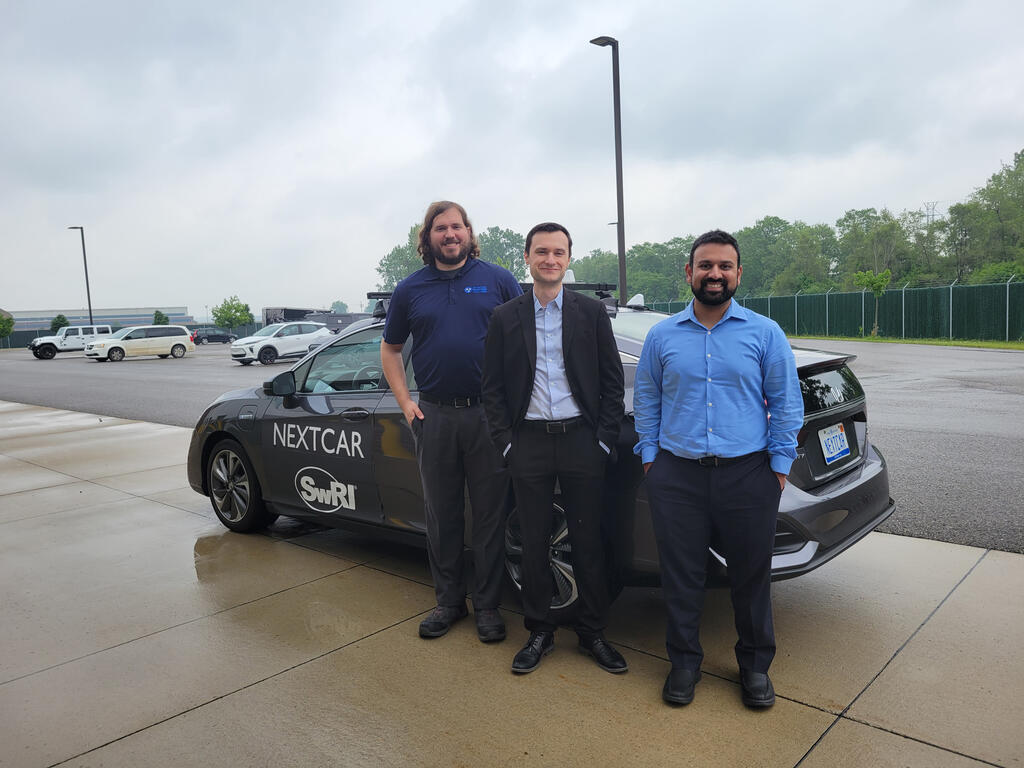
The SwRI NEXTCAR connected and automated vehicle project demonstrated up to 30% energy savings. The project recently wrapped up after eight years of research and development. SwRI engineers, left to right, Robert Harold, Stas Gankov and Piyush Bhagdikar, showcased the vehicle at the June 5, 2025, ARPA-E Field Day event at the American Center for Mobility in Ypsilanti Township, Michigan.
Stas Gankov: Thank you. It's great to be here.
LP: So, two phases and eight years later, the system is available to license, ready to bring some real time and energy savings to drivers and transportation operators. So let's understand how the NEXTCAR software works, starting with an overview of Connected and Automated Vehicle or CAV technology. Such an important part of this program. So what is CAV technology?
SG: Sure. So CAV stands for Connected and Automated Vehicle technology. And what it does is it combines connectivity and automation generally to try to enhance the safety and effectiveness of vehicles and also just to provide some driver convenience as well.
So there are two pieces here. We have connectivity and automation. Connectivity enables the communication to other vehicles or infrastructure. V2V allows direct vehicle to vehicle communication. We have also V2X, which is vehicle to everything communication. Now, this term encompasses just more broadly the communication that vehicles can have with other parties. This could be vehicles, this could be infrastructure, and this also could be some other entities like mapping services or any kind of online platforms.
LP: When you say the vehicle is talking to other vehicles or talking to the infrastructure, what enables that communication? How is that happening?
SG: So, there are a couple of different mechanisms. One is we have a dedicated radio inside the vehicle that enables that communication. And so it's a gateway for vehicles to transmit information from the vehicle to other entities. It could be as simple as a cell phone level chip. So a 5G or cellular V2X communication that enables the transmission of information from the vehicle to the infrastructure.
LP: Okay, so these are specially equipped vehicles. Is the infrastructure also specially equipped to talk to these vehicles? Or are these components that are already installed on infrastructure right now?
SG: Right. So in most cases, this is specific and specialized equipment, although it doesn't have to be that special. So I mentioned 5G. So a lot of times, the components inside of a cell phone can be installed and are installed in vehicles. And that enables that communication aspect of it. So it doesn't have to be something that is unique.
Although with NEXTCAR, we did use a unique form of communication called DSRC, Dedicated Short Range Communication radios. And these utilize the 5.9 gigahertz spectrum to communicate information from these specialized devices on the vehicles to the specialized receivers on infrastructure or other vehicles.
LP: Okay, so let's get to that second part of CAV technology, the automation. What are we talking about when we say these vehicles are automated?
SG: So automation really allows for the vehicle to perform some tasks that would normally be performed by a human driver. An example would be lane keep assist or adaptive cruise control, which allows the vehicle to maintain its lane and also maintain a set speed or distance to other vehicles in front of it.
Now, there is a varying level of automation that vehicles have nowadays, and the Society of Automotive Engineers actually has a leveling system. So they have levels from level 0 to level 5 autonomy that explains the level or the limitations of this automation at each level. And so things like lane keep assist, they can provide some lower levels of automation, because you still need a lot of human level involvement in operating the vehicle.
When you go into the higher levels of automation, level 4 and level 5 vehicles, for example, then they can actually perform a lot of the tasks on their own. With level 4, you are constrained somewhat geographically with where the vehicles can operate. And then level 5 is that ultimate goal, where cars can just drive wherever.
LP: On their own.
SG: On their own.
LP: Yeah. Okay. So some great terms there to remember throughout this conversation. Connectivity, vehicle to vehicle, that's V2V, and vehicle to everything is V2X, and of course, automation. So that brings us to the ARPA-E NEXTCAR project. First, how did this journey begin? Eight years ago, what inspired the project? Why did SwRI take on the challenge of developing this technology?
SG: So ARPA-E is the Advanced Research Projects Agency for Energy. This is an agency within the Department of Energy. And something that they do, they're really focused on these high risk, high reward kind of projects. So for them, doing incremental changes isn't really that interesting, you could say.
And improving the vehicle efficiency from, let's say, the conventional engines, so spark ignited engines, fuel combustion engines, we've gotten to a point where they are fairly efficient. And you can have these incremental steps, incremental changes in efficiency. But we've already gotten to quite a bit of a pretty good level of that efficiency.
So ARPA-E said, hey, we know that this technology is coming up. We know that vehicles are becoming more automated. We know that there are more connectivity options for vehicles. Can we use that information rather than relying or rather than focusing exclusively or mostly on the safety aspects and the convenience aspects of CAVs, can we use that information to actually make the vehicle drive more efficiently?
So what ARPA-E set out to do is they said, here we have a challenge for you. Can you get a 20% energy improvement using this information, using connected vehicle technology without changing the actual hardware, without changing and making the engine more efficient with new technology, new hardware. Can you just use that information to make the car drive smarter?
Now, at SwRI, we have the expertise to tackle this ambitious goal, and we have multiple divisions working on powertrains, working on hybrid electric vehicles, combustion engines, and we have the expertise in our other divisions to work on the automation piece, the connectivity piece as well. We have developed our own technology for highly automated vehicles, and we're also working at the forefront of this connectivity enabling infrastructure for vehicles and for infrastructure.
LP: So the Institute was really poised to take on this challenge. We have all the components needed to make this happen. And the CAV technology was there generally for safety, as you mentioned. That was the base of the technology. And as you said, ARPA-E said, hey, can we do more with this existing technology and make cars more efficient? So then you have this whole package, safety and efficiency. So let's talk about the NEXTCAR system. How does NEXTCAR use CAV technology to achieve that efficiency, to reduce energy consumption and emissions?
NEXTCAR uses a combination of tools, including eco-driving, eco-routing and optimal power split to increase energy savings. The software suite works with conventional, hybrid and electric vehicles without changing the vehicle engine or hardware.
SG: NEXTCAR is a suite of technologies that targets different parts of the vehicle, of the existing vehicle platform, and it uses different methods, different mechanisms to achieve energy efficiency without relying on any hardware changes. There are different techniques like eco driving, eco routing, power split optimization, lane change assist, merge assist, platooning. All of these are different techniques that can allow the vehicle to operate more efficiently.
Using the information from the surroundings through connectivity and through automation can enable us to make use of and tailor these techniques specific to that vehicle and make them more likely to save energy and more likely to save fuel than if we were to just allow the vehicle to not have any insight into the kind of environment that it's in, the kind of drivers, the kind of driver that we have behind the wheel. This is actually something that doesn't rely necessarily on human input, and it's really just trying to solve these different optimization problems.
And with optimization, what we're trying to do is we're trying to create and solve these complex problems that have a lot of constraints. So you have, for example, your constraint as a driver with how close you can follow another car. You are also constrained with how quickly you can accelerate and decelerate. And you're also constrained by traffic lights that you're encountering.
What NEXTCAR allows us to do is to use all that information and create the most optimal speed that the car needs to travel. Let's say if you're approaching a traffic light, you don't want to necessarily stop at the red light and then have to accelerate a second later because the light changed to green. If you knew the information ahead of time, you might be able to slow down before approaching the light and then cruise on through that light as soon as it changed to the green state.
LP: And again, we want to stress this is without changing the vehicle hardware or the engine. This is just a software solution, as we said at the top. So I want to get a little bit more into two of the techniques you mentioned, eco routing and eco driving. You did touch on it a bit already, but these are two important features of the system. Let's talk a little bit more about these two techniques.
SG: So I was actually going through some of my things and some of the old things in my house, and I found a GPS device.
LP: Oh, I remember those.
SG: Yeah, back before the pre-smartphone era.
LP: Put them on your dashboard.
SG: That's right.
LP: Yeah, press a few buttons.
SG: And then you'd punch in a few buttons. You punch in your destination, and it would route you to the destination. And actually as I was going through that, I powered it on and I looked at it and it had an eco route option on it. And I said, well, this is interesting. I wasn't aware of this device having this technology.
And I looked into it, and it gave you the option of putting in what is your average city highway miles per gallon, and then what is your highway miles per gallon. And what these mapping platforms do is they have a huge database of information with all of these different streets and the types of streets that they are, the types of speeds that you can achieve on these streets, and they route you from point A to point B and combine this whole route. They can say, okay, in this segment, we're traveling on the highway. On this segment, we're traveling in the city.
And you can say, well, if I know that my vehicle efficiency, my miles per gallon, is this on the highway, this on the city, then I know for this route, this is approximately how much energy, how much gas I'll use. If you take this other route, you could say, well, okay, using this information, I might be able to travel on this other route. It might take me a little bit longer, but I'm going to use less energy doing so.
So again, this is not a new concept. But something that something interesting that they've added on is a couple more layers to that original GPS receiver that I mentioned. What they are doing now is they're providing live traffic data in addition to that routing. And with that, now you have the information about how fast is traffic moving right now, not just what is it like on average. Are you driving in the city or on the highway? Using that information.
And then they're also using some high level vehicle powertrain types. So you can make a selection of a gasoline powered or if it's a hybrid electric vehicle or fully electric vehicle. They use that information to make better estimates of how much energy you would use to go from point A to point B.
What NEXTCAR does differently here is we create some very high fidelity models of the vehicles. In our case, for the NEXTCAR programs, for NEXTCAR 1 and 2, we were using a Toyota Prius plug-in hybrid for NEXTCAR phase one. And then for NEXTCAR phase two, we're using a Honda Clarity plug-in hybrid vehicle.
Both of these vehicles, because of the architecture with being a plug-in hybrid vehicle, meaning they have a large battery that can travel, that can take the vehicle electric only for a certain number of miles, usually dozens of miles, and then it'll switch into hybrid vehicle operation.
We can actually create these. We can use the high fidelity vehicle models and create really much more accurate estimates of energy consumption from point A to point B. We can evaluate each option that we have and say, okay, for this particular route, what is the energy consumption for our vehicle? Not just for a generic hybrid electric vehicle. And so that's eco routing.
And then we also have eco driving, which is a separate technique that allows us to drive more efficiently by using the accelerator and brake pedal more gently. You can think of this like hypermilers. So hypermilers, what they do is they use their basic vehicles, but then they are really, really easy on the pedal and they try to maintain some kind of a speed optimal where they don't stop at traffic or they're trying to avoid stopping at traffic lights. But of course, they don't have this information. They're just trying to guess, predict when traffic lights are going to change. They're usually driving slower on the highway.
We try to do something similar, but limited to something that is reasonable, something that a reasonable driver would drive. We don't want to slow down the vehicle too much. We don't want our vehicle to be a hindrance to other vehicles on the road. Using this connected information, now we're using the information from traffic lights. We're looking and seeing where other vehicles are located, and we're predicting what those vehicles are going to be doing ahead of us so that way we can better manage our speed knowing or anticipating what the vehicles in front of us are going to do.
And that allows us to really be more gentler on the brake and accelerator pedals. That allows for less energy transaction losses. Anytime you step on the gas pedal, you're using a lot of energy to do that. And then you press on the brake, and you're wasting a lot of energy to heat. And if you keep doing that over and over and over, you're wasting just a lot of energy to go from the same point A to point B, that another driver who didn't have to do that, who just pressed on the accelerator pedal gently, didn't brake, and they're just going down the same road, they're going to be using a lot less energy.
LP: So yeah, that was my next question. How is this technology an improvement on existing mapping apps? And it sounds like NEXTCAR, this technology, gives the driver a more personal experience. And really, as you said, tailors the suggestions on routing and speed, et cetera, based on the actual person's experience, the actual car they're driving.
SG: And it actually builds on existing mapping platforms. Within NEXTCAR, we were using commercially available mapping platforms, because we didn't want to solve the A to B problem. There are so many companies out there that created these maps and created different mechanisms for determining a route from point A to point B.
And what we said is, okay, now that we have access to these routes, and we have an estimate of the speeds that you could expect to travel on these routes and the traffic information, now we can use that to make our vehicle drive more efficiently based on a collection of routes that we've identified as being the most optimal.
LP: Okay, so how does NEXTCAR optimize power usage in a hybrid vehicle, going from that battery electric power to gasoline? How is this approach, how is the NEXTCAR approach better than current methods?
SG: With NEXTCAR, we are using the predictive algorithms to optimize when we use the gasoline combustion and when we use the electric propulsion systems. So one of the most common techniques that hybrid vehicles employ is really to try to use the battery energy first and then use the gasoline engine. Because batteries, like I mentioned, are more efficient. And so you're going to prioritize using that first and then use the gasoline. That might not be the most optimal thing for you to do.
If you knew ahead of time that you'd be driving, let's say, first on the highway and then in the city, you would want to maybe use your engine first, because it's more efficient first, and then save that battery energy to drive in the city later. So if you knew that ahead of time, and that's what NEXTCAR and the connected vehicle technology allows us to do, is to anticipate what you're going to be encountering in the future and optimize those systems that way.
The other technique I would say is if you have a smaller battery, like in a regular hybrid electric vehicle battery that does not plug-in and it offers maybe a mile or half a mile of range, typically what those vehicles do is they try to maintain the battery state of charge at about 50% or so, because you don't know if you're not connected what the driver is going to be doing next. Are you going to be pressing on the accelerator? Are you going to be braking?
And so you want to have a little bit of a buffer, both with electrical energy stored to allow you to press on the accelerator and some energy capacity left over for the battery to fill up whenever you start to brake. And you don't know which one you're going to be doing next.
With connected vehicles, you're able to actually more accurately predict which one you're going to be doing next. And so if the car knows that there is a red light ahead of you, it knows more than likely that you're going to be braking, and it's okay to use some more of that energy, the electrical energy now, because you're going to be recharging that battery again once the car starts coming to a stop.
LP: And will the car know or anticipate that red light ahead because of the vehicle to everything connection? Is that what we're talking about when we say the car's talking to the infrastructure?
SG: That's exactly right. And that's one of the key components here as well, is the vehicle to infrastructure. And when I say infrastructure, a lot of times we talk about traffic lights. That's what I'll refer to. And traffic lights with these specialized radios and some interfacing can give you the information about when the traffic light is going to be changing phases. So when it's going to flip from red to green or vice versa, and how long you have in that particular state.
And knowing that information now, you can optimize whether you're going to be accelerating and maintaining your speed to try to make it through that light, through that intersection, or if you might as well start braking earlier because you don't want to keep accelerating and then just having to stop again once you get to the light.
LP: And then in a hybrid situation, it helps the vehicle determine if electric is the better option or gasoline is the better option depending on what the driver may encounter.
SG: That's exactly right.
LP: Okay, and we want to say it again. NEXTCAR is for electric, hybrid, and conventional vehicles. So it doesn't really matter what you're driving. This system can work with any vehicle, really. So you've given us some examples of how NEXTCAR works on the road. But let's talk about this a little bit more. How would an everyday driver use the NEXTCAR technology? If you can, walk us through a typical use scenario.
SG: This is an excellent question, and I can't believe we haven't been asked it in the same fashion. And the reason is a lot of people are interested in what's behind the scenes, how does it work, et cetera. But how would you use it?
LP: I want to know how would I use this? Like, how is this useful for me?
SG: And ideally, you wouldn't know it. You wouldn't know that it's actually working, because it would work in the background, and you wouldn't have to actively do anything to change it.
Now, I'll use the few technologies that we've talked about, eco routing, for example. You might want to type in your destination into your vehicle and that would pre-compute both your eco routing option. So it would route you to the most eco-friendly way. And again, like I mentioned, there might be a time penalty associated, but not necessarily. It could be equally as long in duration, but one route might save you more energy depending on your vehicle type.
The other possibility that it would do is when you type in your destination, now it knows your entire route and it can plan your battery energy consumption as well if you're driving a hybrid vehicle. Now, you don't have to, again. It depends on the type of vehicle that you have. And each of these techniques is tailored towards a particular type of powertrain.
The other example is for eco driving. What we're trying to do and what we've done with this program is actually integrate it with the vehicle's pedal, both accelerator and brake pedals. Essentially, you're driving a smart cruise control system. So rather than setting your car to drive at 70 miles per hour on the highway, now the car is actually reacting to not only the speed limit, but it's also reacting to vehicles ahead of you.
And so if cars ahead of you or cars 10 vehicles ahead of the car in front of you are starting to break, your car knows ahead of time that it's going to be coming up to a slower situation, and it might start to preemptively slow down. That way, you're not just wasting energy. Again, coming up to this bottleneck and then having to brake at the very end.
And so like I said, ideally all of this just happens in the background. We have developed with both NEXTCAR phase one and two programs the ability for a driver to visually see a speed that they should follow, the most optimal speed. But again, this driver advisory is just an extra step, if you will. We kind of want to take the driver out of it and give them fewer distractions and have the car take on more of these automated responsibilities.
LP: But is the car driving itself just yet in this scenario?
SG: And it doesn't have to, but it can. So like I mentioned, there are different levels of automation. And a car doesn't necessarily have to drive by itself from point A to point B. But you could employ the smart cruise control system where it's active only on the highway. And now you're not having to press on the pedal. You're maybe just having to steer.
Or if you had a vehicle that has a higher level of automation, now you might actually employ steering mechanisms as well, allow the vehicle to steer, and then use some of these other techniques that I mentioned, like lane change and eco merge, which would allow you the vehicle the most efficient way to merge with other vehicles.
LP: So a typical use is just punching in your destination and following the route.
SG: That's right.
LP: Yeah, Okay. Not bad. So NEXTCAR uses SwRI's ranger localization technology. How does the ranger system integrate into the NEXTCAR platform?
SG: This is a really interesting technology. Advanced vehicles use many sensors to accurately map out their location and their routes. And this is just another one of those sensors. It happens to be a downward facing camera, so it's a camera pointed at the ground.
What this allows the vehicle to do is map out the ground. It actually takes pictures of the concrete, of the asphalt, whatever it's driving on, store it in a database. And then when the vehicle has to drive on that surface again, it's able to use pattern matching to figure out exactly where it's at. Localization is really just the ability of the vehicle to understand where it's located.
GPS systems are very commonly used, but GPS systems are also limited in where they can be used. If you are in an urban environment, you might have less accuracy to be able to use these systems. And so this kind of, it's another sensor that allows you to precisely localize your vehicle and know exactly where it's at.
And what's interesting is that the roads don't generally change that much. Because it's a road, and each pattern that you might notice is like a fingerprint on the ground. And the vehicle, the sensor suite, is able to just determine exactly where it's located, where it's been.
And of course, one of the common questions we get is, well, what happens if it's raining? What if it's snowing? What if the ground is covered up? And sure, that'll make the problem more difficult. You can have some occlusion, you can have some obstruction of the ground and still have the system work. But of course, the same applies to most automated vehicle technologies.
LP: Okay, so the ranger technology is yet another tool for NEXTCAR to understand the car's location. And there are some sensors involved in that along with the camera, the ground facing camera. How is the NEXTCAR system using sensors in other capacities?
SG: The NEXTCAR vehicles that we've developed use several other sensors besides ranger. So ranger is a sensor. Other vehicles are LiDAR, or it's a laser that can allow for the vehicle to detect other objects around it. It uses radar, again, to detect vehicles in front of it. And it uses these sensors in combination with the L4 autonomy stack, which again, it fuses all of this information to determine where the vehicle is located and where it should go next. What is the next path for it to take while avoiding the obstacles in front of the vehicle?
LP: Okay, so we want to point out that the NEXTCAR system isn't just for passenger vehicles, but also for public transportation, for fleet vehicles. So how does NEXTCAR technology benefit large scale transportation operations?
SG: NEXTCAR was developed primarily with the thought of passenger vehicles in mind. And so NEXTCAR 1 and 2 both use plug-in hybrid passenger vehicles. But you're absolutely right. We can employ this technology in other vehicle types like fleets or public transportation vehicles.
Eco driving, for example, can be used on heavy duty vehicles just as they would on passenger cars. It's just, again, you're using a different vehicle platform. The energy costs associated with accelerating and braking are that much higher, and so there's that much more potential for using this technology to improve the benefits of the vehicle, the efficiency of the vehicle.
LP: So, you started this wanting to achieve a 20% energy savings. You achieved a 30% energy savings. So for one driver, that's significant. But when you are in charge of an entire fleet of, let's say, 18 wheelers or public transportation like buses, as you said, that is potentially a huge savings when you're employing the NEXTCAR technology.
SG: And not even 30%. You take a couple of percentage points and multiply that by thousands of vehicles, and that's huge savings. And so we do have these various techniques that depending on the vehicle can give you up to 30%. But even if an auto manufacturer, even if a fleet owner wants to use just one of these techniques to help improve their fuel efficiency, that could be massive for their business.
LP: Okay, so in June, you demonstrated the NEXTCAR vehicle at the ARPA-E field day in Michigan. So what was the response to the vehicle? How did it feel to show off the finished product after eight years of development?
SG: The response from the audience was really positive. And we were one of 11 teams for NEXTCAR 1 and one of four teams for NEXTCAR 2. Everyone who was involved in this program and people who know about this program are really, really excited by the achievements that we were able to have.
It was pretty bittersweet for me, because it has formed it has been a part of my career for such a long time, and it's a formative part of my career. And for the broader team as well at SwRI, it was great to see. Great to see the combination of everything, of eight years of work, both the connectivity, the automation, all of these things just coming together. And then showing the audience, having them be able to sit-in an actual vehicle and drive them around a test track, test facility and show them this is how the technology works. This is what it would be like if you had NEXTCAR in your car.
LP: All right, so what is for NEXTCAR? When will we be buying vehicles with this system installed?
SG: Some vehicles may already have this installed or at least some elements of this. And automakers are integrating advancements into both passenger cars and heavy duty vehicles as well. This might be more active on that heavy duty vehicle scene. You can see that there are a variety of technologies available for large trucks, things like advanced mapping. That's been around for some time. But again, like I mentioned, there are some limitations with current mapping techniques.
There are other techniques where they can look at the grade of the road ahead of the vehicle and preemptively shift the vehicle's gear train into a more optimal state. And again, some of these techniques, they're coming online and they're bringing in this connectivity piece that is just, again, more broadly, it's just information from our surroundings. It's not necessarily this one radio, but the information can come from the internet. It can come from these radios, from whatever the source may be, from sensors detecting other vehicles. Combining all of that, and then solving these complicated optimization problems to improve the energy efficiency of a certain vehicle.
And so rather than seeing NEXTCAR be deployed as here's the next NEXTCAR vehicle, it's more like, here's a piece of the next car program integrated into this vehicle. And then maybe next year, we add one more piece to it. And so it's going to be a continuous and evolving process.
LP: Okay, and you have a call out for collaborators, for a potential joint industry program or consortium. So what is your vision for a consortium?
SG: We are gathering input from companies and trying to understand the interest in this technology. Some of the automotive companies are wanting to take this technology in-house because they are considered to be trade secrets, and they might want to maintain some competitive edge over others. But some of this can be more pre-competitive in research and research focus. And so a consortium makes sense to develop this technology collaboratively.
There's so much information out there that we've published, that other teams have published from NEXTCAR and from other companies as well that is publicly available. And we want to continue to develop this technology further. It's, again, not necessarily having to take all aspects of NEXTCAR, each one of these algorithms, connectivity, and automation. But perhaps it is just taking a specific technology that is high impact that we can now develop further and work with collaboration with other entities.
LP: Okay, so one little fun note I wanted to mention here. You walked into this building today. So just to let our listeners know, we are in a remodeled building here on the SwRI campus. And so it was offices and labs in the past, and today, it's part of our media department. So my podcast studio is here in this building. And when Stas walked in today, he's like, hey, I used to work in this building. So tell us about your experience.
SG: Yeah, it's really interesting. I've been at Southwest Research for about a decade now, a little bit more than a decade. And when I started working here, I spent some time in this building and when it was primarily being used for the development of some of these automated vehicle technologies and some of the connected vehicle technologies as well. And so I was working with some of these teams to help develop the messaging, the actual messages that would be communicated between vehicles and between infrastructure.
And then I transitioned into this other role where I now used that information, used the information that would be communicated to now make better decisions for the vehicle. So it's really interesting, but it's such a big campus. I mean, we have hundreds of buildings here on site. And just the ability to work with so many different researchers from diverse backgrounds. It's an exciting place to work at.
LP: So kind of the seeds for NEXTCAR were planted way back then. And here you are eight years later, telling us about the almost finished product, the project being completed now. And so very much a full circle moment.
SG: Yeah. When I pulled into the parking lot, I said, wow, this is like eight years ago when I was coming into work one morning.
LP: Yeah. All right. So he's very familiar with this building. So the NEXTCAR technology was recognized during development with an R&D 100 award and named one of the most significant innovations of 2021. It was much anticipated and receiving attention before it was complete. Now it is nearly a full package, ready to bring meaningful energy savings to drivers and fleet operators. So, to learn more about NEXTCAR and to get in touch with Stas, visit connectedpowertrain.swri.org. That's connectedpowertrain, one word, dot swri.org. So thank you for being here, Stas, coming back to your old stomping grounds to tell us all about the advanced NEXTCAR technology.
SG: Great. Thank you for the opportunity.
And thank you to our listeners for learning along with us today. You can hear all of our Technology Today episodes, and see photos, and complete transcripts at podcast.swri.org. Remember to share our podcast and subscribe on your favorite podcast platform.
Want to see what else we're up to? Connect with Southwest Research Institute on Facebook, Instagram, X, LinkedIn, and YouTube. Check out the Technology Today Magazine at technologytoday.swri.org. And now is a great time to become an SwRI problem solver. Visit our career page at SwRI.jobs.
Ian McKinney and Bryan Ortiz are the podcast audio engineers and editors. I am producer and host, Lisa Peña.
Thanks for listening.
[MUSIC PLAYING]
Connected powertrain technology improves fuel efficiency and performance in conventional, electric and hybrid vehicles with software and data by leveraging onboard sensing and external connectivity via vehicle-to-vehicle (V2V), vehicle-to-infrastructure (V2I) and vehicle-to-everything (V2X) technologies.
How to Listen
Listen on Apple Podcasts, or via the SoundCloud media player above.