



SwRI celebrates a first in its 78-year history — the purchase of land and construction of a new facility outside of its San Antonio headquarters. The 33,000-square-foot, \$18.5 million building, equipped to advance national defense technology, is strategically located 3 miles from Robins Air Force Base in Warner Robins, Georgia. The building, featuring conference rooms, labs and new equipment, is expanding SwRI capabilities in electronic warfare (EW) research and development. The state-of-the-art Warner Robins space, which officially opened August 20, is a launch pad for innovative ideas and inspiration.
Listen now as SwRI EW experts and Warner Robins engineers Winfield Greene, David Brown and Jarrett Holcomb talk about the new opportunities in the space, the forward-looking EW development underway and why Warner Robins is the ideal community for growth and progress.
Visit Advanced Electronic Warfare Solutions to learn more about SwRI’s next-generation electronic warfare systems for military and defense.
Transcript
Below is a transcript of the episode, modified for clarity.
Lisa Peña: For the first time in its 78-year history, SwRI built an office outside of its Texas headquarters in Warner Robins, Georgia. The new state-of-the-art building supports Air Force and national defense advancements. We're learning about the progress and breakthroughs in the Georgia office more than 1,000 miles from SwRI's home base. That's next on this episode of Technology Today.
[MUSIC PLAYING]
We live with technology, science, engineering, and the results of innovative research every day. Now, let's understand it better. You're listening to the Technology Today Podcast presented by Southwest Research Institute. From deep sea to deep space, we develop solutions to benefit humankind. Transcript and photos for this episode and all episodes are available at podcast.swri.org. Share the podcast and hit that subscribe button on your favorite podcast platform.
Hello and welcome to Technology Today. I'm Lisa Pena. We're excited to highlight SwRI's Warner Robins office, home of the advanced electronic warfare team. Electronic warfare technology detects and intercepts enemy radar signals to protect military personnel, aircraft, ships, vehicles, and infrastructure. SwRI launched a Warner Robins office in 1990, in leased office space, but daily operations, a growing staff, and an increased workload created the need to expand.
In the Institute's 78 years, the new 33,000 square foot, \$18.5 million Warner Robins building is the first SwRI-owned property outside of headquarters. It officially opened last month. SwRI director of the Advanced Electronic Warfare Department, Winfield Greene, joins us from the all-new Warner Robins office, where the grand opening celebration continues. Thank you for being here, Winfield.
Southwest Research Institute celebrated the official opening of a new $18.5 million, 33,000-square-foot facility in Warner Robins, Georgia, on August 20. The building includes space and equipment dedicated to the advancement of electronic warfare and defense technology.
Winfield Greene: Good morning. Thank you for having me.
LP: So let's start with the research and development unfolding in the Georgia office. What are engineers and researchers working on in Warner Robins?
WG: Well, electronic warfare is a little bit difficult to explain, but the easiest way to explain it is that it involves signal processing, where we receive enemy radar signals, we process those signals to understand them, and then we compare them to known radar signals. And then we have responses that we send back to confuse the enemy, so that the enemy will not be able to fire their missiles at that Air Force assets or Navy assets or Army assets. So it's all about taking in a signal, processing it very quickly, very, very quickly, and sending back false information that will confuse the bad guys.
The main customer that we've had since 1990 when the office was started is the sustainment of the current electronic warfare systems that fly on the current Air Force platforms, like an F-15 or an F-16, for example, A-10s. Those are what we call fourth-generation technology. And our job has been to help keep those in the fight, keep them functional. But at the same time, if the enemy makes adjustments to their ability to send out radar signals, we have to make adjustments to be able to detect them and defeat them.
So there's always a constant battle in the race for superior technology between the good guys and the bad guys, and that's what we are at the forefront of on a daily basis.
LP: All right. And so for those of us new to electronic warfare or new to that term, can you tell us a little bit about what your work in electronic warfare is aiming to achieve? You said defeat the bad guys. Can you give us a little bit more of an explanation of how that might play out?
WG: Is as simple as I can make it, when we send our airplanes into enemy territory, the bad guys are trying to, essentially, prevent us from doing that. If we have a mission to deliver a payload, they want to make sure that we don't accomplish our mission.
So they are, essentially, armed with missiles to defeat us. So if the pilot comes home safely, that means we've done a good job. If we have confused the enemy to the point, I mean, I tell you one, if they fire a missile at us, but they shoot so far away from us that it's not even close, the pilot doesn't even sweat, we've done a good job.
If we've confused them enough that they can't even determine what direction to point their missile in, then we've done a great job. But every day the pilot comes home is a day to celebrate that we've done the job that they've asked us to do, which is to keep the pilot safe.
LP: All right. Really important work you do there in Warner Robins, Georgia. So let's get into some history about this location. How did SwRI with headquarters here in San Antonio, Texas, where I am now, how did we expand into Warner Robins, Georgia? What is the backstory there?
WG: Well, you used to have a director by the name of Walt Downing, and this was back
LP: Who's still here as our executive vice president.
WG: Yes. And he was a director back in the late '80s to early '90s. And he was already supporting Kelly Air Force base, which was one of the five air logistics centers in the Air Force back in that time. And because he was supporting Kelly Air Force base, which is right down the road from you guys at corporate headquarters, he began to look at how can he support the other four air logistics centers.
And so he developed a strategy to visit, get to know them, find out what their needs are, to see what capabilities that the Institute had that could be applied to solve problems for the Air Force at the other air logistics centers. One of those being Warner Robins, Georgia, the Warner Robins Air Logistics Center at Robins Air Force base right in Middle, Georgia.
And as he was making all of his travel plans to all of the different locations, because there was one at McClellan, out in Sacramento, California; Ogden, Utah; Oklahoma City, Oklahoma; and then Warner Robins, Georgia. That was the other four besides Kelly Air Force base in San Antonio.
Mr. Downing decided that he needed some help, and if he was going to make progress in Warner Robins, he needed a guy on the ground in Warner Robins. This is before we ever had the first office. It had to start somewhere. So it started with Mr. Downing hiring a fellow named Larry Sapp. He's passed away now, but I've known Larry Sapp for 40 years.
And he hired Larry Sapp to work out of his trunk of his car to make contacts with the Air Force customers, and eventually, that led to us getting booked work or a new contract. Which then led to us getting our first on-site Warner Robins location office, which was leased space that would handle like a total of five employees. And I think they might have had three employees after they signed their first contract.
LP: So again, this was all back in 1990. What were the early days like, with those first few employees?
WG: Yeah, that was a day. I wasn't here then, but I know the guys that were, and that was one of those days where everybody had to pitch in and do everything. There was not two jobs that was too small or too menial for anybody. For them to be successful, everyone had to pitch in and help with every part of the project.
And the main customer that they started supporting back then is still a happy customer today. It's still related to electronic warfare. Some of those systems that they were supporting in 1990 are still systems that we support today. We've had a 35-year run of good customer relationships and good customer support.
LP: So let's talk about this new office that just opened last month. What are some of the features that make it a state-of-the-art building? You've come a long way since those early days.
WG: Yeah, listen, I'm going to answer that question. But before I do that, I want to brag a little bit about some of our employees.
Image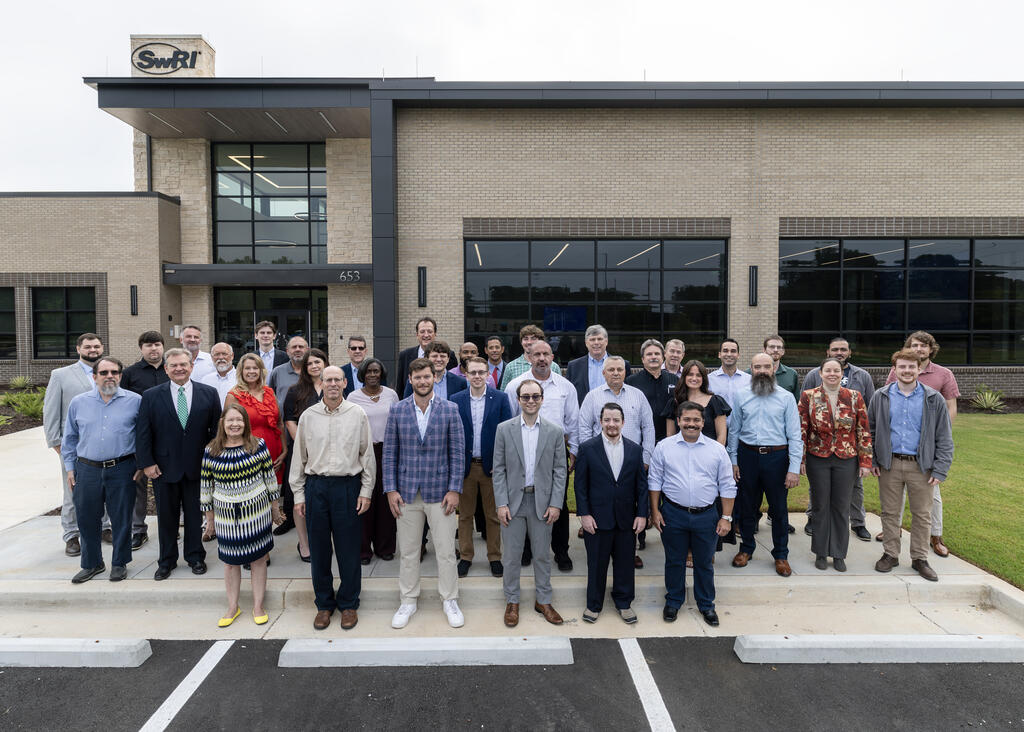
SwRI’s Warner Robins staff members gather in front of the new building that sits on 8 acres. The property is the first SwRI-owned facility outside of the Institute’s Texas headquarters in its 78-year history.
LP: Of course.
WG: The Institute, Southwest Research Institute, is very dedicated and committed to investing in internal research and development. And we have taken advantage of that here in our Warner Robins office that we push, I push from a leadership position, that we have a very robust internal research and development program, where we stay on the leading edge. If we're going to continue to be able to outsmart the bad guys that have intent to do us harm, we have to stay on the leading edge, even if we're supporting older technology. As we replace the older technology with new technology, we have to stay ahead, and we do that through internal research and development.
So if you're in the entertainment business and you sing music, the awards you get at the end of the year are called Grammys. If you're also in the entertainment business, but you're in the movies, the award you receive at the end of year is called an Oscar.
LP: Yes.
WG: And same with the Emmys for daytime television, Tonys, for Broadway. In the engineering business, which is what we are, the award that you get at the end of the year if you're outstanding is called an R&D 100 Award. We have two gentlemen that have R&D 100 awards sitting on their desk. And I think that in the grand scheme of things, to have two people with those type of awards.
I mean, it's like when you get up and come to work every day, we come to work with movie stars or rock stars, except they're engineers, and they've got the same Grammys or Oscars sitting on their desks. They're just called R&D 100 Awards. And we have two of those here in Warner Robins, because of the kind of technology we do, what they were able to achieve through a Southwest Research funded internal research program.
And now, one more brag I gotta make besides those two guys, there's an electronic warfare community. There's a national association for that type of profession. It's called the Association of Old Crows. The Association of Old Crows has been around for 70 years. It's a worldwide organization for all people that have business with the management manipulation of the electromagnetic spectrum or electronic warfare. They have a new award that they started three years ago. The Future 5 is a worldwide award. Your competition is around the globe. The award is handed out at the International Convention in Washington, DC every December, and they've only been doing this for three years. They pick five people that are under the age of 30 that are making the maximum contribution for the advancement of technology in the electromagnetic spectrum.
So they've only given this award to 15 people on the planet over the last three years. Two of those 15 people work in the Warner Robins office of Southwest Research Institute. That is amazing. There's not two other people in this city that have received that award, and there's two right here at this one location, for Southwest Research Institute. That's amazing.
That tells you now, you want to know about the building and its facilities, capabilities, what makes it advanced technology capable. A big part of that is, I just had to give my employees room to grow, but we were able to start from a clean slate of what do we really need to be able to be successful? What do they need besides just space? So a couple of things that we did that I think make our building very attractive for our customer. We wanted to make this building attractive for our customers so that the Air Force, who's right down the road, would want to come over here and take advantage of these facilities. So one of the first things we did was we said, we've gotta have a large conference room, that when they need to have a conference, they think about calling us first.
We have 400 hertz power which emulates aircraft power so that when we bring in an electromagnetic, an EMC pod, electro countermeasure pod, we can hook it up, power it just as if the airplane was sitting right inside our building.
We have a lot of expensive equipment that allow our guys to apply their ideas to specific sets of hardware through the manipulation of either software or firmware. The last thing I want to say about the new building that seems to have everyone appreciative of is we have a very nice break room, kitchen community.
Now, more people are doing more bonding and team building because we have community place for lunchtime, including a screened-in back porch that overlooks a pond that we have, where there's always ducks and geese. It helps, I think, to let people release some pressure and stress of the normal job, decompress for a little bit, make some friends, and then get back to work. And I think it adds something very nice to our building.
LP: A truly outstanding staff, as you noted, in this new state-of-the-art building, so a lot of great things happening in Warner Robins. We know the SwRI office is located 3 miles from Robins Air Force base, and that was a strategic decision. But tell us about your community. Why is Warner Robins the ideal place for SwRI's world-changing research and development?
WG: Well, the customer is a high-tech customer. So the community is a high-tech community. It's not just that Southwest is alone in being an advanced technology company right here in Middle, Georgia, supporting the Air Force base. But because of the nature of the requirements that the Air Force has that are managed here at Warner Robins, the platforms that are managed here at Warner Robins, it's a natural place for a very large community of engineers with a lot of defense contractors in this space. And we just want to make sure that we are leading the pack as far as advancing the technology to support the customers.
The particular customer, the primary customer that we support here in the advanced electronic warfare department is the electronic warfare program office for the Air Force. It's about 500 employee office. They manage all airborne electronic warfare assets for the Air Force for any airplane that flies, that has electronic warfare equipment on it. Radar warning receivers, digital warning receivers, electronic countermeasures, all of those scenarios are managed by the Air Force at Warner Robins, which is why it's important for us to be co-located with them.
LP: So we're really in the middle of an Air Force community. So what do you envision for the future of SwRI in Warner Robins, Georgia?
Image
SwRI Director of Advanced Electronic Warfare Winfield Greene discusses the history of SwRI in Warner Robins, the world-changing research and development unfolding in Georgia and the advantages of being part of an Air Force community.
WG: Yeah, the one thing that we've made tremendous progress on in the last couple of years is our relationship with Air Force Research Lab. The Air Force Research Lab is in Dayton, Ohio. That office, it sits in Dayton, Ohio, but it reports to the gentlemen in Warner Robins at Robins Air Force Base.
Where the new technology gets applied is through the advanced technology Office in Dayton, and we have current contracts in place with them, current relationships, and certainly have a strong working relationship with them as well as Warner Robins.
LP: So a definite expansion of your current work.
WG: Yes, ma'am.
LP: Winfield, again, congratulations on the new building and on your outstanding staff that you have there in Warner Robins. And thank you for telling us about the national defense work happening in Georgia and giving us this insight into the dynamic Warner Robins community.
WG: Yes, ma'am. It's been my pleasure.
LP: It is an exciting time in Warner Robins with the new building, but also with the next generation, forward-looking research and development underway. SwRI Institute engineer, David Brown, joins us now to tell us about two advanced areas of EW technology development. Thank you for being here, David.
David Brown: Thank you very much for having me, Lisa. It's good to be here.
LP: So your team is really taking it to the next level with neuromorphics and cognitive electronic warfare. We'll talk about neuromorphic capabilities and explain what that is in a moment. But let's start with cognitive EW.
We know electronic warfare technology detects, intercepts, and stops enemy signals to protect the warfighter, but making that capability cognitive adds a new layer. So what is cognitive electronic warfare?
DB: So cognitive electronic warfare has the idea of placing some human cognition, some human reasoning into the electronic warfare process. For example, cognitive electronic warfare system would typically autonomously sense the environment, which would allow it to develop an understanding of the threat situation around the aircraft or around the vehicle, make independent decisions for an appropriate response as necessary, and then be able to put those decisions that it makes into action and determine if the action that it has taken has the desired effect, and if not, the cognitive system can actually adjust what it's doing in order to improve performance.
A building block of this is, in a cognitive electronic warfares, the cognitive sensor, the cognitive sensor include human-like reasoning and sensing the environment. A lot of times, if you think about the way we do it as humans, when we look at the environment around us, we don't look in terms of 1's and 0's that traditionally you think of in computer processing. But we see colors, we see different graduations that are hard to put into a traditional processing.
LP: So we are talking about an autonomous system that is making decisions and it's sensing its environment. So how is it doing this?
DB: Building on some of the traditional processes that we've had for years, looking at how we can more effectively use those, we apply the advances in artificial intelligence, machine learning, the advances in processing capability, which allows us to do a lot of processing now that we couldn't do even five years ago. It would have been impossible.
So as we sense the environment, there's two ways of doing it. The traditional method of digitizing the world around us and looking at new ways of looking at digital data and processing it more smartly than we did before.
LP: Let's talk about the algorithms that you use here. So you're training these algorithms, also to be able to do this. Can you talk a little bit about that?
DB: Sure. Using a lot of the artificial intelligence algorithms that have been developed, we develop a lot of very advanced data. We use tools that we have gotten from the Air Force Research Lab and other DOD agencies to develop data that's needed for the processing of training these algorithms. The data itself is very complex. A lot of the AI that you hear about in the world, and especially with these electronic warfare systems, the quality of the data that you generate impacts the ability to train the system and the eventual performance of the system. So in order to ensure that the algorithms are trained properly, we spend a lot of time analyzing the data that has been generated, the data that we have in order to ensure that we have good quality data.
These algorithms, we, typically, will load on advanced GPU servers that we have at Southwest Research. We'll do training, which may take a process of several weeks and then evaluation of the algorithm that has been trained.
Finally, after we go through that process, we load these on the embedded system itself. So these are the cards that we go within electronic warfare system. So essentially, what we're doing is plugging in smarts or reasoning power into a standard electronic warfare system. Allows it to look at the data that's available within electronic warfare system that we have, make decisions on that, and affect the way that we engage with the world around us.
LP: So how do these autonomous cognitive systems make airspace safer than traditional EW systems for US pilots?
DB: So traditional systems do not adapt as quickly as the threat is adapting. The threat systems that are in the world are proliferating in number around the world, but they're also becoming much more complex than just a few years ago.
They're adapting very quickly to the environment, and they're adapting to the jamming, the responses of traditional electronic warfare systems, and they can adapt much faster than the older generation electronic warfare systems.
So a cognitive electronic warfare system has some of that reasoning capability of a human, and so we're able to adapt and react much more quickly than the older systems. So that human-like reasoning ability, coupled with very fast response times, allow that cognitive system to adapt as quickly as the threat and provide that protection that is needed for our aircrew.
LP: And what phase of development is cognitive EW, and is it already in use?
Image
SwRI Institute engineer David Brown tells us about cognitive electronic warfare (EW) and adding neuromorphic processing to EW capabilities.
DB: There are some isolated elements that are in use. Typically, those are on the more sensitive programs. So there are some pieces that are being used and being discussed. But in general, the technology is changing very quickly.
There's rapid algorithm evolution, and that's matching the rapid evolution, it's sensor technology, the processing technologies that are becoming available. So the capabilities today are advancing at a very rapid rate. So a lot of the cognitive systems, especially on the sensing side, are fairly mature. But the whole loop of interacting with the environment is less mature. So some of these systems are in use in limited contexts, and it needs to expand beyond that to match the threats that we're seeing today.
Beyond the technical aspects of the cognitive systems, cognitive electronic warfare, there's an acceptance issue across the Department of Defense. It's more difficult sometimes to get an AI-enabled system accepted for flight and for use within military systems. There's some human inertia that looks at the way that we traditionally do signal processing, the way that we traditionally do electronic warfare, and expect that the future will still be the same.
One of our goals is to help change that mindset, to show that these advanced electronic warfare systems can be safe. They can do a job very well, and they can bring capabilities that our older electronic warfare systems simply cannot do.
LP: So let's jump into neuromorphics. That adds another layer of technology into electronic warfare capabilities. So what is neuromorphic computing, and how does it advance electronic warfare?
DB: So neuromorphic computing is an approach to information processing that takes advantage of some of the studies that have shown how biological organisms process data, and especially humans. But a very simple example would be insects, an ant, for example, show very advanced problem-solving capability. They have the ability to form teams. They have the ability to work together for a common goal. And they do all this with a very small processor, a very small brain, a very limited communication system, and they use a minute amount of power, which is very important to a lot of our systems.
Humans also are capable of incredibly complex reasoning, both in our academic settings. Also, we're able to do complex, coordinated movements which are required for our top musicians, or top athletes. Yet the human brain uses relatively low energy compared to some of our more advanced traditional processing systems, like a GPU.
So the idea with neuromorphic computing is, if we can study the processing capability of biological organisms, and we can learn how they can increase the efficiency of their processing capability, we can learn to build more efficient processing systems ourselves, which include complex reasoning with relatively little energy consumption.
For electronic warfare systems, this means that we can incorporate very sophisticated reasoning capability into systems with limited power consumption. That means that since we're using less energy, we have less heat generated, and we can operate with cooler temperatures, which is important with small spaces.
Both the lower heat generation and also, the lower power consumption allows us to put some of the electronic warfare capability on smaller vehicles, say a UAV or something like that, rather than requiring a large platform in order to bring that same capability. So all that together means that neuromorphic processing allows us to perform more sophisticated processing in a smaller area, and it applies the need, the processing to where it's needed to protect American military lives.
LP: And I love that you use the ant as an example.
DB: Well, another example that we don't typically think of is a dragonfly. Has a very rudimentary visual system, a very small brain, and yet it does a complicated intercept on flying insects. It flies, it predicts where the insect will be, and it's able to intercept it in flight. Again, for us to do that in a standard processor, like a standard CPU that we'd use in a desktop or a GPU that we might use in an embedded system, that's a complex algorithm.
And for us to do that with a GPU, we'd use lots of power, lots of energy, and spend a lot of time generating that answer. Yet the dragonfly, with almost no brain and a very rudimentary visual system, is able to do that with almost no energy.
So again, if we can look at those kinds of processes that nature is using and be able to adapt those to the problem sets that we have, that brings a lot more capability with a lot more energy use, and adds it to a lot smaller platforms than we're currently able to do.
LP: So plenty to learn from nature. So I want to talk a little bit about your new building. How does your new building support your work? Is there added space or labs that make this type of research easier or faster?
DB: Well, one of the nice things about the new building is we have space for servers for training AI algorithms. Being remote from Southwest Research main campus in San Antonio, a lot of the algorithms that we want to train, we develop very large training data sets, up to a terabyte of data. location, the ability to train algorithms and having the servers located in Warner Robins would make that much easier.
Trying to copy those between San Antonio and Georgia is very problematic. It's sometimes multiple days in order to copy all the data between sites. Having a location, the ability to train algorithms and having the servers located in Warner Robins would make that much easier.
LP: What inspires you to do the work you do? What motivates you?
DB: So first of all, in my younger years, I was actually one of the military members, the aviators that depended on electronic warfare for safety. And knowing that what we are doing will ultimately be used to help safeguard lives of a younger generation of military aviators is a huge motivator to me. I'm just glad to be able to support that, be able to help protect the service members.
In addition, it's just phenomenal that I get to work with some world-class researchers. Both here in the Institute, a lot of great folks that have expertise that is hard to find a collection of people like this anywhere else.
And then in addition, because of the work we're doing, especially with neuromorphic computing, we're able to interact with researchers, really, around the world in different settings. So working with people that are passionate about what they are doing is contagious. And the work, the research that we do is very challenging, but it's also very rewarding.
LP: You have a great team in Warner Robins, and your extended team also sounds like everyone contributes so much to your mission. So, David, with your cognitive EW work and your neuromorphic work, you are really looking ahead at these emerging technologies shaping the future of EW and developing new ways to protect military personnel.
Thank you for your insight and giving us a glimpse into what the SwRI Georgia team is tackling day to day.
DB: Thank you, Lisa.
LP: And there's more to explore in Warner Robins. Joining us now is SwRI engineer and advanced electronic warfare manager, Jarrett Holcomb. He's here to talk about SPARTA, the System Performance and Real-Time Analysis. And ATHENA, the Adaptive Threat Environment Acquisition. Thank you for joining us, Jarrett.
Image
SwRI engineer and Advanced Electronic Warfare Manager Jarrett Holcomb explains SPARTA, the System Performance and real time analysis, and ATHENA, the adaptive threat environment acquisition, two SwRI EW tools.
Jarrett Holcomb: Awesome. Thank you, Lisa, for having me
LP: So before we dive into the technical stuff, I gotta find out, how's life in the new building?
JH: It's like a dream come true. I will tell you that. It has been absolutely fabulous being in the new building. Everyone here is extremely grateful for this opportunity that we have right here to advance our lab capabilities, to have a new office space, to have new conference room capabilities, new collaboration areas, everything like that. Everyone is super grateful, and we're like a well-oiled machine now and really, really looking forward to being in the new building.
LP: All right. Lots of great new space to get into the work that you do. So let's talk a little bit about what you do there in Warner Robins. I want to start with SPARTA. So how do you describe this tool? Again. SPARTA, the System Performance and Real-Time Analysis. What does it do?
JH: Yeah, so in SPARTA, it was actually founded as a presidential internal research program. But the story behind it actually started off with us working in government labs, testing out electronic attack systems. And what we realized was that there's a really large gap in the current testing and evaluation tools, specifically for electronic attack systems.
And that led us to say, hey, well, we think we can solve this by developing and doing internal research and providing a tool to use for these particular types of systems. And what we found was that electronic attack signals are intentionally programmed to be confusing to sensors all around. And that's one of the purposes of electronic attack, is trying to provide confusion to various different sensors.
But because they are designed to be confusing, in and of itself, it was very, very difficult to actually develop a test system to verify that it was doing exactly what you told it to do. And that's where SPARTA really comes in and really, really shines is that it's software that analyzes this electronic attack signals, so inside the spectrum, the signals that it's producing.
And it verifies at a very, very low level that it's the system that was programmed to do something is doing exactly what you told it to do. And that's really where it shines. It's a very, very congested spectrum nowadays. There's tons and tons of signals out there. So being able to pull out and isolate each one of these signals is a very, very important step that SPARTA does.
LP: So how does this software solution contribute to electronic countermeasure system development? Why is it critical to analyze these systems?
JH: These systems, they're of grave importance to, not only the DOD, in general, but also to the warfighters. It is literally protecting warfighters lives. So going through the extra steps of drilling down into the low-level details of the signals that it's producing and verifying that it's doing exactly what you think it's doing is of grave importance, especially to those warfighters that are flying these systems, because they are designed to protect those warfighters.
So in order to verify that they are actually producing exactly what they're doing, not only helps the DOD as a whole, ensuring that the systems that they spent millions of dollars on are actually performing adequately, but also, to that warfighter who is flying on an aircraft with electronic attack system that's designed to protect them from incoming missiles. That is hugely critical in order to analyze those systems.
LP: I mean, you guys are doing some really important work, so it's important to get it right.
JH: Absolutely. Absolutely. Yeah, we're talking about life and death here.
LP: So we just learned about electronic warfare, or EW. So how are electronic countermeasure systems different? Because that's what SPARTA is testing, these electronic countermeasure systems.
JH: Yeah. So electronic warfare is a really broad term. So electromagnetic warfare is another term often used as well. But it deals with all sorts of things, not just the transmittal side, which is often referred to as electronic countermeasures or electronic attack, but it also deals with the receiving end of it.
Your situational awareness is another term. So what's going on inside the spectrum that gives you that situational awareness is also a part of electronic warfare. So when we talk about electronic countermeasures, that's typically referring to an electronic attack system that goes after, encounters specific other signal.
So in the particular in the particular case that we deal in, there's a radar system. The radar system is designed to locate a specific type of airplane or something along those lines, a countermeasure system could come in and outputs some sort of signal in order to confuse or deny that particular radar signal that was emitted and try to confuse it, or at least make it not function as properly as it would have been without the countermeasure system in effect. So that's the overview of what countermeasure system is. It is a countermeasure to a particular sensor in the environment.
LP: When we say electronic warfare technology detects and intercepts enemy signals, are these countermeasure systems part of the interception?
JH: Yeah, the countermeasure parts are the part of the interception portion of that, the transmittal of more signals into the environment in order to confuse or deny an enemy sensor inside the spectrum.
LP: ATHENA is another SwRI EW tool, ATHENA, the Adaptive Threat Environment Acquisition. So what does ATHENA do, and how is it different than SPARTA?
JH: So ATHENA is more on the receiving side. So SPARTA is an evaluation tool for the transmission side, so the electronic countermeasure signal side. What ATHENA does is ATHENA is a receiver. So it provides situational awareness to a warfighter to determine what's going on inside the spectrum in the environment.
You and me right now, we're talking over the spectrum right now. I'm in Warner Robins here in San Antonio. And so without the spectrum, we wouldn't be able to be talking right now. But because we have the spectrum that allows us to talk, do communications, it lets us do other sorts of things, such as in the radar use case.
Let's say, the radar lets you know where target is, how far away it is, how fast it's moving, other things like that. What ATHENA does is ATHENA looks at the entire spectrum, looks at the entire spectrum to say, hey, look, Jarrett and Lisa are talking on the spectrum at this particular frequency. There's a radar over here at this particular frequency, and may be it's trying to fire a missile at me and other things like that. That's what ATHENA does. But what's special about it compared to other receivers is that it looks at a very, very large, what's called instantaneous bandwidth. So one of the use cases or examples that I like to present to people is, do you know the comic strip Where's Waldo?
LP: Yes.
JH: The goal of Where's Waldo is that you got this really big image. There's tons of little people walking around, and you gotta pick out and find Waldo. He's wearing that red-and-white striped T-shirt that everyone probably is able to recognize.
Well, traditional receivers can be pretty narrowband. So they're not looking at the whole picture that is the spectrum. Well, what ATHENA is doing is it's looking at the whole picture. So imagine, traditionally, if you were to have a Where's Waldo comic strip, but you only looked at the top left corner and then you moved over a little bit, and then you slid it to the right to look at the right-hand corner.
And then you got to move it down, and you gotta keep going over. And you only looked at just a little portion of it every time. It would take you a really long time to find Waldo.
Well, what ATHENA does is ATHENA looks at the full comic strip to try and find some of these really difficult signals to find so that it can find it faster than traditional methods. And that's what ATHENA does, is it lets warfighters find particular signals of interest a lot faster than they would have been able to find using traditional methods.
LP: OK, that's a great explanation, because I can picture that. I see ATHENA searching this busy, big picture, and the picture is the spectrum. And ATHENA can spot Waldo immediately, plucking out that difficult signal that is named Waldo.
JH: Exactly. Exactly. So ATHENA differs from SPARTA in the fact that it doesn't unnecessarily evaluate electronic attack signals, but it's receiving the full spectrum, trying to find these really difficult signals for the warfighter in order to tell the warfighter there's these dangerous signals over here, and it does that really, really fast.
So it's not quite an evaluation tool. So SPARTA is an evaluation tool. ATHENA is a tool for the warfighters to use on the front lines in order to receive and detect these really, really dangerous signals.
LP: Two separate tools in what they accomplish, but both important when we're talking about electronic warfare tools. So great. Thank you for explaining that. Now again, these are highly technical software solutions. So thank you for helping us understand them better.
So I want to look at the big picture now. How do SPARTA and ATHENA contribute to the important SwRI mission of research and development to benefit humankind? What is your take on that?
JH: So I think that both of these, and specifically, when we talk about researching electronic warfare, I take extreme pride in the fact that what I'm doing is affecting warfighters' lives. The whole mission behind electronic warfare, in general, is to protect these warfighters against some really dangerous technology and weapon systems that are going after some of these warfighters, and they're using the spectrum to try to do that.
We're using the spectrum, using SPARTA to evaluate electronic attack tools in order to make sure that that pilot comes home safe and using ATHENA in order to detect these really dangerous signals a lot faster. Both of those are contributing almost directly to the warfighter's safety, which in turn, directly supports SwRI's mission of benefiting humankind as well. So I see those two linked together extraordinarily tightly. And I do believe that we are doing research that is benefiting those warfighters as well as the DOD community, in general.
LP: Really great explanation of this advanced technology that is shoring up national defense. Thank you for helping us understand the important work you are doing in Warner Robins, Jarrett. And I great things are ahead for you in the new office.
JH: Awesome. Thank you so much for having me. I really appreciate the time.
LP: So much happening at the SwRI Warner Robins location. Thank you to our three guests for telling us about their work and community. Visit ew.swri.org to learn more about SwRI defense software and electronic warfare capabilities.
And thank you to our listeners for learning along with us today. You can hear all of our Technology Today episodes, and see photos, and complete transcripts at podcast.swri.org. Remember to share our podcast and subscribe on your favorite podcast platform.
Want to see what else we're up to? Connect with Southwest Research Institute on Facebook, Instagram, X, LinkedIn, and YouTube. Check out the Technology Today Magazine at technologytoday.swri.org. And now is a great time to become an SwRI problem solver. Visit our career page at SwRI.jobs.
Ian McKinney and Bryan Ortiz are the podcast audio engineers and editors. I am producer and host, Lisa Peña.
Thanks for listening.
[MUSIC PLAYING]
Southwest Research Institute develops advanced electronic warfare (EW) systems that sustain legacy technologies and integrate state-of-the-art capabilities for air and ground applications. We are preparing for the next generation of advanced electronic warfare through our applied research and development for military and defense.
How to Listen
Listen on Apple Podcasts, or via the SoundCloud media player above.