



SwRI’s DARWIN® reliability and safety software analyzes aircraft components for fracture risk, improving safety in our skies. The visualization tool provides insight into potential structural problems before a malfunction occurs. DARWIN takes aircraft data and converts it into a picture of fracture risk, analyzing when a break could occur and pinpointing potential fracture “hotspots.” The software has supported aviation safety for decades and now, it is flying into new frontiers.
Listen now as SwRI engineer and DARWIN developer Jonathan Moody discusses the catastrophic engine failure that led to the software’s development, how it works to keep aircraft and passengers safe and DARWIN’s rise outside of aviation.
Visit DARWIN® to learn more about the safety software’s capabilities and applications.
Transcript
Below is a transcript of the episode, modified for clarity.
Lisa Peña: An SwRI software solution has been a trusted aircraft safety tool for decades. Developed after a deadly mid-flight engine failure, the award winning design assessment of reliability with inspection, or DARWIN, software is used globally in aviation. Now DARWIN is flying into new frontiers. That's next on this episode of Technology Today.
[MUSIC PLAYING]
We live with technology, science, engineering, and the results of innovative research every day. Now, let's understand it better. You're listening to the Technology Today Podcast presented by Southwest Research Institute. From deep sea to deep space, we develop solutions to benefit humankind. Transcript and photos for this episode and all episodes are available at podcast.swri.org. Share the podcast and hit that subscribe button on your favorite podcast platform.
Hello and welcome to Technology Today. I'm Lisa Peña. The design assessment of reliability with inspection, or DARWIN, software has been recognized with an R&D 100 award and is known for a flawless safety record. DARWIN assesses aircraft safety risk before there's a critical malfunction, determining the probability of a fracture and pinpointing problem areas. SwRI engineer and DARWIN developer Jonathan Moody is here today to tell us about upgrading the software for aviation and beyond. Thank you for joining us, Jonathan.
Image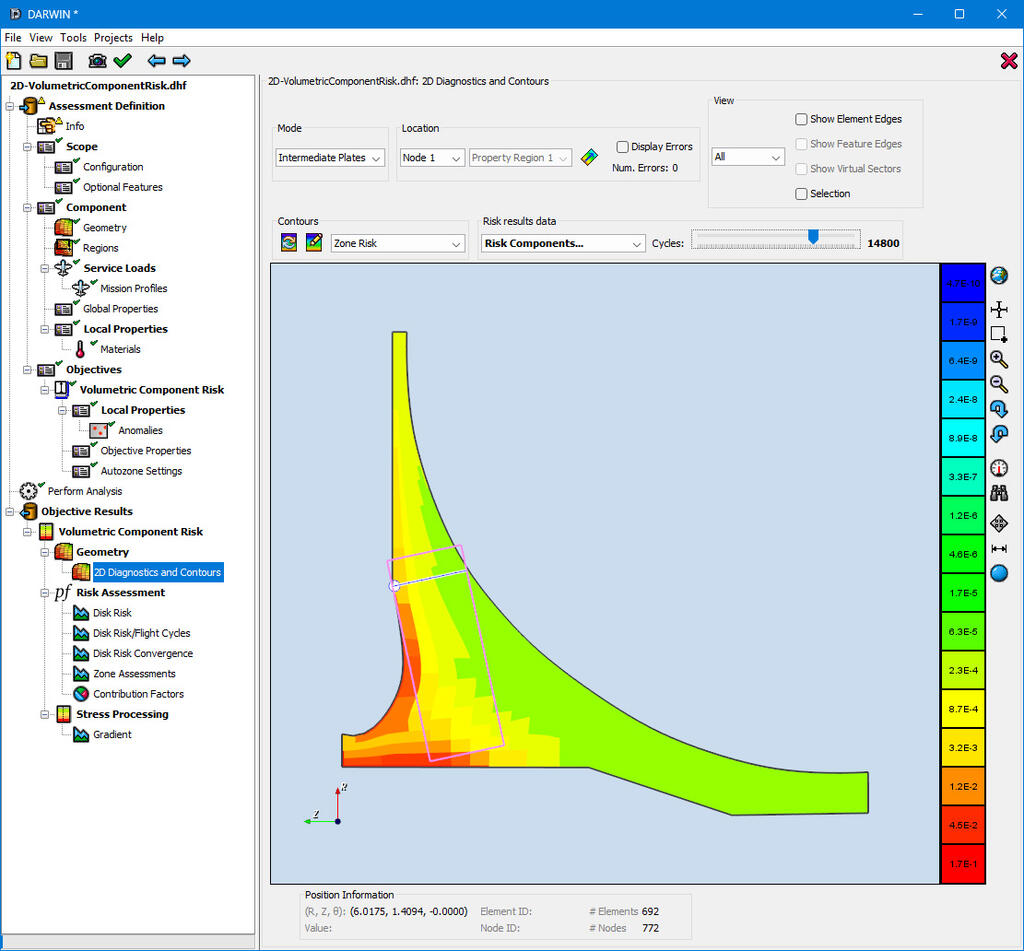
DARWIN® generated a fracture risk map of an aircraft engine impeller using service loading conditions, material properties and anomaly distribution data. The color scale represents fracture risk probability, with red highlighting the regions most susceptible to fracture.
Jonathan Moody (JM): It's a pleasure to be here. I really appreicate this.
LP: So, Jonathan, since the DARWIN program initiated in 1995, DARWIN has expanded into really a global aviation safety solution. So let's start with the software's origin story. Tell us about the catastrophic event and the investigation that followed that created a need for the DARWIN software.
JM: Yes, absolutely. Well, you know, ideally, in safety-critical industries, we want to identify risk early and put protections in place before anything bad happens. But sometimes you don't get that luxury. Sometimes, there are just failures that are so rare and unexpected that we only discover the risk until after there's a catastrophe.
And unfortunately, DARWIN was born from one of these moments. And it began in July 19, 1989, United Airlines flight 232. It took off from Denver, and it was flying to Chicago.
And then it suffered a catastrophic engine failure mid-flight. It pretty much was forced to attempt an emergency landing in Sioux City, Iowa. And unfortunately, that ended in a catastrophe. Plane crashed, and you had, of the 296 lives on board, 112 had passed. And this was considered, widely considered, a miracle, I mean, that anyone survived.
It was a pretty atrocious crash. Investigators came in from the National Transportation Safety Board. They did their investigation, and what they found was there was a microscopic defect that was in a critical engine component. And pretty much, it had grown slowly over time until eventually, it had ruptured.
And I always described it as a grenade going off. These engines are spinning very, very fast. And so when one of these parts rupture, it just throws metal debris.
And that metal debris went through the aircraft and literally the worst case scenario, it severed the line to the hydraulic control systems. And the crew at that point had virtually no way to control the aircraft. So that's what brought the airplane down, but the investigator, they found something else that was just as concerning, and that was that the existing safety measures designed to try to prevent these sort of events, they were not capable of stopping similar failure in the future. Pretty much what had happened in Sioux City was bound to happen again. And at that point, this is when, really, the momentum began to build a software program to mitigate that risk.
LP: OK, so this was a really catastrophic mid-air engine failure, then that investigation followed, and it was found that, as you mentioned, really, it started with a microscopic failure, which is unbelievable that that, then, could grow to cause such a huge accident and loss of life. So once that was identified, walk us through the next few years and steps. How did SwRI become involved in developing this software, and what did they want the DARWIN software to accomplish?
JM: Yes, yes. So after that event, the Federal Aviation Administration came in, and they established a collaboration with key members, key industry leaders among the aircraft engine manufacturers. And their main goal was singular. It was to prevent the loss of another life, to prevent this catastrophe from happening again.
And one thing that came out of that was the development of a new risk-based approach for assessing engine safety. So rather than just predicting when failure would occur, like the traditional safe life, we call it, method did, rather, it would predict the likelihood that failure would occur. In essence, it was effectively accounting for the elusive nature of that particular flaw that had brought down flight 232.
And so from there, once they had that new methodology, well, it led to, actually, a new federal safety requirement. And basically, any aircraft engine flying over the US, no matter the point of origin, would be required to prove compliance using this risk-based approach. And so once we got through that, this was really just the beginning because now, they needed a way to make this risk based approach readily accessible, readily usable by engineers and aircraft engine manufacturers.
And then this led to an initiative and an invitation for companies to come and organizations to get involved in developing a tool to pretty much translate this approach into a sustainable, commercially-supported software application. In 1995, the institute won a bid to translate the approach into a sustainable, commercially-supported software application. And that is when DARWIN was born, its first release coming out in 1997.
And of course, the big push and big motivation for this was to help ensure that safety critical decisions were informed by quantified risk. At its core, that is DARWIN's principal mission. Basically, the previous approach is which we call safe life methods, right.
What they would do is they'd predict when failure would occur, and then they'd have safety factors on it. Like, in other words, let's say you thought the part might last for 5,000 flights. Well, then you might say, well, we're going to say it's going to last for 3,000 flights just to play it safe. We don't get anywhere close to where we think failure will occur.
But what was really unique about this particular situation, this flaw, it's very elusive. It wasn't really its impact wasn't captured in those approaches in predicting life. And so we had to account for the fact that these flaws are very difficult to find. They can be very different sizes when they do occur.
And kind of going back, they're just very rare. And so it wasn't enough to just try to say, OK, I have a flaw this size in my part. How long would my part last? You have to account for the fact that that flaw can be anywhere, and you don't know where it is. You don't know if it's in that part or not.
The reality is, if this flaw exists in the component, the chance of failure is relatively high. Just the saving grace is that they're not likely to occur. That's the key, right? But when they do, you have to account for it, and you have to be ready for it. And DARWIN sets out to solve that problem.
LP: What was the exact flaw that started this whole process in motion?
JM: Yes, it's called a titanium hard alpha defect. Pretty much during the melting process, so when you're manufacturing these parts, you melt the metal. And then when it forms, sometimes you have these little pockets where you might have a few grains of this metal that didn't quite melt, didn't melt.
And so what it essentially represents is like a void in the component. And even though it's microscopic, it's very tiny, over time, as you turn that engine on and off, this little defect can start to grow a little bit, ever so slowly. And you don't see it.
It's small. You don't even know it's there. You have no reason to suspect it's there.
And then eventually, after some period of time, once it starts growing quicker, it's like an exponential curve. It can just take off, and boom, it ruptures. And so you can think of it as imagine you have a stick, and you're holding both ends of the stick, and the stick has a little crack in the middle.
So when you bend that stick over and over, you eventually start seeing that crack starts to grow, gets bigger. It gets longer. You do that long enough, eventually, it gets easier to bend that stick, and eventually, boom, you can snap it.
And so this is essentially what's happening with the titanium hard alpha defects. And like I said, they can be in the interior of the part. So you just have no idea they're there.
And so it can be a silent killer, really. That's what it can be. And so that's what we're looking to find.
LP: We jumped on board to find this solution. So how does it work? How does DARWIN work?
Image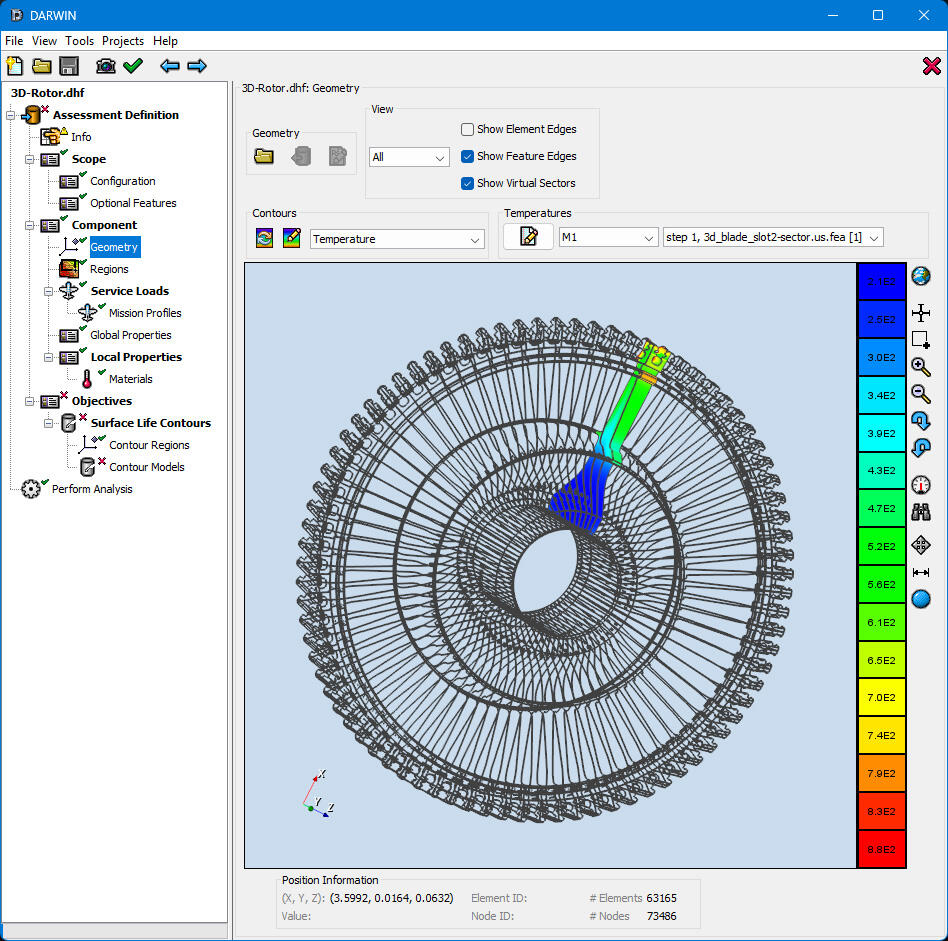
DARWIN® is capable of analyzing complex structural components, such as the fan disk shown here. The software can predict fracture risk over time, identifying when and where failure is most likely to occur. These predictions support a range of safety-critical decisions, including certification, inspection planning, design improvements, warranty assessments and life-extension programs.
JM: At its core, DARWIN, pretty much, it brings together information that normally lives in separate places. So for instance, a stress analyst has stress information about the component. They also probably have the engineer who's doing the finite element analysis, they have the digital representation of the component.
What does it look like? Where are the curves and what's going on? And then you have materials scientists who do the material characterization.
They know how this part behaves. They know how a flaw inside of a material might grow over time when it's subject to certain loads. So you have all these pieces of information. What DARWIN does is pretty much take these pieces of information, bring them together into the software application, and then it does a simulation.
So it says, OK, let me now go in and say, OK, for this use case, how long would the crack take to cause failure? And to back up a little bit, we can do that because we account for variability. So in other words, not every material, batch of material, is the same.
If you take a bunch of sticks, and you put a little crack in them, you start bending them, they're not all going to break at the same time. And so it is with these components. Now, it's not as extreme, right, the variability. They're all pretty close.
But you have variability in the material and the load. It all might be used a little bit differently. One's flying from LA to Miami, another one's they're flying over different environments. And then you have the anomalies.
Like I said, it's random in its nature in the sense of when is it going to occur and where is it going to be and how big is it going to be. So DARWIN accounts for the variability, and because of that, it can go in and do thousands, millions, of simulations to say, OK, here's one scenario. The crack is this big. It's in this location.
The material is going to behave this way, and we're flying over here. OK, how long does the part last? OK we get a number.
Then it does it millions of times. Then it can come back and say, OK, now we can build a statistical model of what's going on. Now we can tell you the likelihood that you'll have failure at some given amount of time.
LP: So let's talk about that a little bit more in depth. What kind of input does DARWIN need to produce an accurate assessment?
JM: Yes, and we talk about that a little bit. But DARWIN can take in many inputs. But at the core, at the very minimum, DARWIN needs pretty much a digital representation of the components. We call these finite element models.
You can think of it as LEGO®s. You want to build a car with LEGOs. It's a representation of the car, but we build it using a bunch of little blocks.
And that's what a finite element analysis essentially is. So it's our digital representation of the component, and then we also need to know loading histories. And basically, we need to know how the part is used. So these loading histories, it tells us how the component is stressed, how severely, and just it gives us an idea of the underlying operating conditions in it.
And then other basic things would be like fracture mechanics models, material anomaly data. Once again, we have to know how the anomaly is behaving, what's going on. How is the component going to respond to the presence of anomaly, how quickly is the crack going to grow in the anomaly?
Right, so we take all this information, really, and we put it together. And this gives DARWIN the complete picture of what's going on, what might lead to failure. And I should add, right, there's many other variables DARWIN can take in, many other inputs DARWIN can take. DARWIN supports a lot of different types of analyses. But ultimately, ultimately, what we've learned through the years is that there's the handful of key inputs that really drive the failure, principally.
LP: So once DARWIN has all this information and is conducting this analysis, what insights does DARWIN provide overall?
JM: Yes, and this is really where DARWIN shines. The real value of DARWIN is that it doesn't just give a yes or no answer. You're going to fail or you're not going to fail. It shows how risk evolves over time and why and where.
One of the key core insights DARWIN provides is what we call probability of fracture. Basically, instead of just assuming a party's either safe or unsafe, DARWIN quantifies the likelihood that failure will occur pretty much as you accumulate cycles. So in other words, as you fly, as you use the aircraft engine component as it flies, it's gaining more and more cycles. It's accumulating usage.
And naturally, your risk begin to go up. The longer you use it, the more time the crack has to grow if it exists. So that's one of the key core principles, inputs, or outputs, insights DARWIN provides. Pretty much, it allows the engineer to simulate how changes in design, material quality, and even inspection strategies can affect risk.
So that's one core capability. Another one is very closely related is cycle to failure. This, pretty much DARWIN can come in and predict when failure is likely to occur.
Now, this is the foundation of computing the likelihood of failure. You recall earlier I talked about the simulations. What we essentially do is we compute the cycles to failure for many different scenarios. That's how we get the likelihood of failure.
So in this case, one of DARWIN's core capabilities is simply doing that — cycles of failure. When is failure likely to occur? And then the last thing I'll say that's pretty big, and this gives a lot of insight, is what we call hot spot detection. Pretty much DARWIN can come in and tell you where failure is likely to occur.
So not just when it's likely to occur, but where is the failure likely to originate? If there's a flaw and it's in this location, this might be where failure occurs. It might happen at this time. And we call the hotspot detection, and pretty much, it allows you to use this very quickly and go and look at a component and have a good sense of what's happening and where they need to be focused through the life and the service of that component.
LP: Once this thorough analysis is complete and this information is compiled, how can a manufacturer use it to make improvements?
JM: Well, once the manufacturer has this information and they have these insights, DARWIN then becomes a decision making tool. So it's not just an analysis tool. And this is the fundamental intention of DARWIN to take these insights to make informed decisions.
Most notably, DARWIN can be used to support safety critical certification decisions. So I mentioned earlier the federal safety requirement, right? All aircraft engines needed to prove compliance with the engine safety requirement.
And so DARWIN is recognized as an acceptable means of demonstrating compliance with that federal safety engine safety requirement. That's a mouthful. And what this basically means is that manufacturers can use DARWIN to perform certification analysis, and those risk assessments are accepted by the Federal Aviation Administration.
Pretty much today, nearly every aircraft engine manufacturer in the world relies on DARWIN for this purpose. So it's a widely used tool, very trusted, lots of eyes on it. And there's obvious reasons why that's a benefit to all of them.
I think on this point, for this particular use case, for DARWIN, it's worth pointing out that manufacturers aren't required to use DARWIN specifically. It's not like you have to use DARWIN or we won't accept it. That's not the case at all. Manufacturers can use any tool as long as it's properly validated with the FAA.
But there's a catch, a little bit of a catch. As you can imagine, developing and maintaining a safety-critical software program is not trivial. It requires substantial time, expertise, resources. And so what DARWIN really provides along this vein is a trusted and accessible alternative.
It's especially beneficial for organizations that just may not have the ability to build and sustain in-house probabilistic tools. And so this is where DARWIN really comes in and gives really great service to the industry.
LP: All right, so as you just explained, DARWIN is serving the aviation industry well. It is used globally, a worldwide safety tool. But a new DARWIN modernization effort is currently underway. So you are improving the tool. So how are developers updating the software?
Image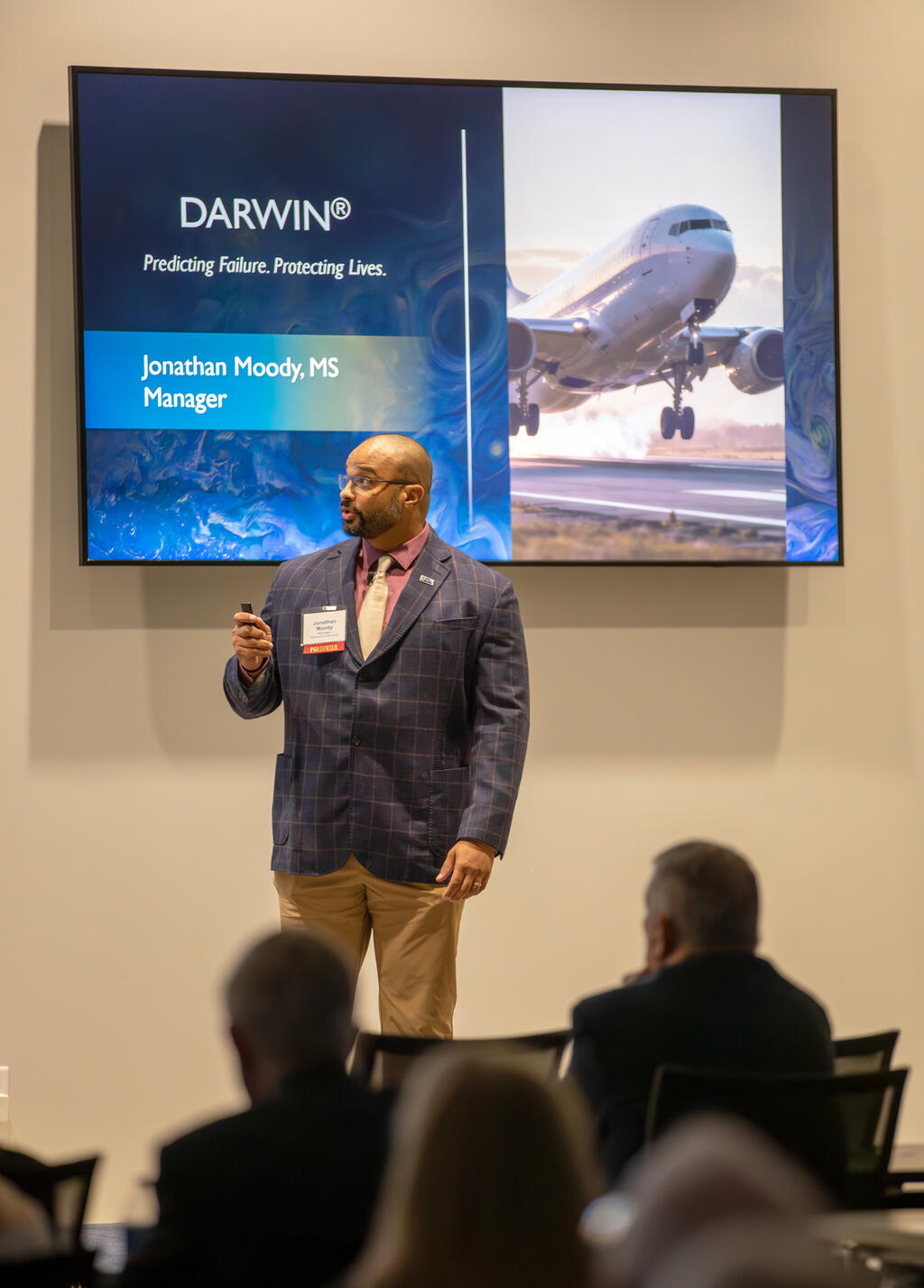
SwRI Engineer and DARWIN® developer Jonathan Moody leads a presentation on the safety software’s capabilities on February 16, 2026, at SwRI’s 78th Annual Meeting of Advisory Trustees and Board of Directors.
JM: Yeah, it's worth noting I've always felt it's one of DARWIN's greatest strengths, fitting for his name, that it has never stood still, that it has evolved through these 30 years aggressively. In 30 years, we're talking about 30 software releases, over 200 major enhancements. If I just add in non-major enhancements, we're talking 400 or 500, 600 enhancements to this program.
And they've been focused on advancing state of the art engineering models, improving computational performance, and extensibility, which is expanding the software to handle new kinds of problems. DARWIN was updated in 2011 and then in 2022 to support two new federal safety requirements. Each of these requirements took very different approaches to mitigating unique safety risk.
So what do we do now? Because we can't stop. We need to be ready to take on new emerging risks, things we just don't know about yet.
And when they do show up and we really hope it's not anything like the Sioux City incident we're certainly very tuned and very aware of these kind of hidden risks today. And we're really hyper focused on trying to find them. But when they do come up, we need to be ready to deal with it.
And there's really three veins that we've been working down in DARWIN to make sure we're ready, and one is automation. It's really reducing the manual effort and streamlining to the workflows so engineers can really focus on decisions rather than setting up analysis. I can go back to a capability we introduced probably about 15 years ago, and it was a way to automate setting up these projects to do the risk assessments.
And prior to that automation enhancement, an engineer might spend two days to a week setting up a project to go do a risk assessment. Well, then, with this automation, we pretty much took that time down to minutes for them to set up the project. And now you let DARWIN spend the day or two doing the analysis and then go work on other things.
So that's one example of just automation, and we continue to look for new ways to make the code more efficient, more expedient, simply because the environment keeps changing. They have bigger computational models now that we need to solve. So we have to keep adjusting with that to make sure that the code can meet those needs.
LP: So DARWIN has a really impressive safety record over several decades, zero reported certification errors, no FAA recalls. How do you think this has been achieved?
JM: Yes, this is definitely something we're very proud of with the DARWIN program. That record is the result of a very deliberate and very disciplined operational approach that we built and refined over the last 20 years, really. And essentially, we've adopted a process framework that's consistent with high maturity process models.
What that means is our processes, they're explicitly defined. There's no question about what needs to be done, when it needs to be done. They're enforced. That is to say, they're managed. They're measured. We have quantifiable metrics to see how we're performing. How are we doing? Are we on track?
And then they're continuously improved. So as we encounter vulnerabilities in our process or as we even identify opportunities to enhance it, we make the... we move to then go and update that process to make sure it's even more efficient, more effective. And at the core of this is a task management system that we've adopted. It's a commercially available tool.
But the thing that makes it very valuable is it's very customizable. So we're able to adapt this task management system very particularly for our team and our use case and how we operate.
And it is, in essence, the engine of our operations. I often refer to it as the assistant operation manager. But it allows us to engage very, very heavy workloads.
LP: OK, well, what you're doing is certainly working. OK, so do you have a most memorable investigation or case where DARWIN has really shined and helped figure out a difficult safety issue?
JM: You know, my honest answer would be a little bit different than people would expect. We are not the end users of DARWIN. We're not the ones who perform risk assessments that directly informed certification or operational decisions.
That work is done by the engineers with the aircraft engine manufacturers. And because of that, we don't make recommendations on component designs, on inspection schedules, or warranties or certifications or any of the other decisions that DARWIN can help inform. Our role is to provide reliable, defensible insight. That's what we do.
And so DARWIN shines not because really, I would say, one dramatic investigation or contribution but because it consistently enables, I'll say, organizations to understand risk that would otherwise be invisible. In that sense, I would say really, our greatest successes, they're the ones that we don't hear about. It's the hidden threats that are identified early.
They're addressed, and they never have the chance to turn into a catastrophe. And I'll say that's certainly the aspect of DARWIN that we're especially proud of that's certainly most memorable. In the end, we are one link in a long chain of safety measures. But it's a very critical one.
LP: All right, so we have something new in the works at SwRI. Tell us about the new Aircraft Engine Consortium that's underway.
JM: Yes, yes. Well, the Aircraft Engine Consortium is really going to be about staying ahead of risk, emerging risk, or any new risks that pop up rather than reacting to it. Even after decades of progress, these hidden risks, they still exist in these complex engine configurations, especially as manufacturers continue to really push the envelope to optimize performance, efficiency, cost effectiveness.
And history has just shown us that. It's proven that these risks, they just are not going to announce themselves. And so really, the consortium, it will bring together the aircraft engine manufacturers and regulators, really, around a shared goal, and that is to keep advancing the technologies and the analytical methods that will be needed to support FAA safety initiatives and objectives.
And so really, it's continuation of the work we've done for the past 30 years. Just it's a different forum now. And in essence, it will create a... we're looking to create a very collaborative environment.
It'll be a collaborative environment where engineering and risk, they can be studied, where data can be shared among the members. And that's really the strength of the consortium, just the shared resources and the shared collective experience coming together to solve these problems. And ultimately, we're going to take full advantage of that, and it's going to be a key part of ensuring that not only does DARWIN stand ready to meet any needs that arise but that the industry stays connected and working together to make sure we can work together to continue to protect lives as we have done.
LP: So a lot of times, when we're talking about projects and programs at SwRI, we like to connect it back to everyday people, to those of us, the public, those of us who will benefit from our projects and programs. So when you're talking about aircraft safety and DARWIN, you're not just talking about military planes or cargo planes or planes for a very small number of people. You're talking about really, essentially, all aircraft — the aircraft we take on to get to our vacations or to travel.
JM: Yes, and DARWIN is really especially focused on aircraft engine components. And these are used in, as I mentioned, most aircraft engine manufacturers use DARWIN to make safety critical decisions. And so these engine components are used in many, many aircraft.
I couldn't give you a percentage. But there's the chance that you step on an airplane, that is an airplane that is under the umbrella of DARWIN and its work and what it has contributed and how it has impacted aviation. Now, that being said, it is used also in applications such as military aircraft, and how do we extend that, especially when it comes to how do we extend the life, perhaps, of a military aircraft engine. But the applications of DARWIN are beginning to expand and go out into other areas, as DARWIN is really just kind of ideally suited to take on a lot of new, exciting opportunities.
LP: All right, so let's get into that. You know DARWIN will have an impact well beyond its original mission. And as you just mentioned, you are extending DARWIN's capabilities to new frontiers beyond aircraft safety, which has been the focus. But what industries could benefit next from DARWIN's capabilities?
JM: Yeah, well, you know, it's amazing because after 30 years, you kind of think opportunities are diminishing, right? But what we found is they haven't. They're actually expanding. They're just... when you look at emerging new manufacturing technologies, you look at new materials, advanced materials being developed, and then just emerging industries like, take the spacecraft industry, rockets being shot into space now.
Just new industries, and it just turns out DARWIN is just ideally suited to handle many of these emerging, a lot of the emerging questions that come along with these new industries because they all have a lot of the same problems. And I think the fundamental point is that many of them are operating in that safety critical, life critical domain. And they're going to have to deal with the challenges of just these unforeseen potential safety questions and potential risks that will emerge within those.
And so one place we've really been digging in right now is additive manufacturing, for example. People might think of this as 3D printing. You see the commercials on TV. Go make your own little toys and things like that.
And that's essentially additive manufacturing. Of course, we're typically talking on an industrial level now. But, they're introducing a lot of really interesting questions because one thing they do... I talked about titanium hard alpha, how the chance of having a flaw is pretty remote.
But additive manufacturing is just the opposite. There are many of them, many of them. And so where we are now is we're talking about how do we model that appropriately.
How do we assess the risk accurately for additively manufactured parts, especially if someone says, I want to use it in a life critical situation? Right now, they need to make sure that it's safe, it's air worthy, it's worthy of wherever it's being used. So that's especially an area where there's a lot of interest now, and we're in a position to be able, we think, to be able to help to mitigate those challenges and those risks.
LP: Yeah, and to just recap additive manufacturing, it's like, it's adding those metal powders almost to a system, and then it builds a part slowly, piece by piece. So it's really intriguing to see. But then, as you mentioned now, we need to know if those parts are safe and what their limitations are. So that's where DARWIN would step in. Has there already been some use of DARWIN in the additive manufacturing field?
JM: DARWIN has been actively explored by organizations who are engaged in additive manufacturing. But I'll say additive manufacturing, when it comes to doing what we call damage tolerance assessments, like assessing the reliability of these components, it's a really hot field right now. It's a really big technical topic and how are we going to approach it.
What's the best way to approach it? There's many great, very reputable people working on this problem because it's very complex. It just so happens DARWIN is just in a position with how it was set up to solve the titanium hard alpha problem, it offers a very ideal solution for also tackling the additive manufacturing problem.
LP: So a lot of new, exciting things on the horizon for this software that's been around for decades. So, Jonathan, you shared that you have worked on this software for 20 years. You started as a grad student working on DARWIN software. So what motivates you to continue improving DARWIN, to stay on this project and take it to the next level?
JM: Yeah, I really do like that question. It's the question I ask myself with anything I do. Why am I even doing this, right?
And we put a lot of time and energy and investment into DARWIN, and we're 30 years, and we're thinking about the next 30 years of the program, and what drives us? And for me, there's really three things that come to mind, and one of them is legacy. DARWIN had played a critical role in improving safety and protecting lives for decades.
And it really is an extraordinary legacy brought on by I can't even name them all, all the people who've been involved in this program. There's been so many of them. They've done fantastic work.
And so there's a sense of pride in preserving that legacy and what the institute has achieved, what DARWIN has achieved and in really impacting just the global aviation industry. And so that's certainly really is a big driver. It's just a legacy.
Two is partnerships. One thing I'll say one thing I especially love about being part of this program is just the people, the people on the team here at the institute. We've got a great team, very diverse, a lot of different people doing different things, highly communicative, highly collaborative.
And it's a really wonderful environment to be a part of. But we're part of a team that transcends the walls of the institute. It's much bigger.
Now, we have our partners in the aircraft engine industry and new industries we're starting to work with. They're people we talked to as if they're institute employees. We meet and talk to them, see how things are going.
But what's really amazing about it is they have that same level of concern and commitment to safety and protecting lives as we do. And to really... just and I think in the end, that's what makes these partnerships so strong. There is that strong underlying goal in working together and leaning on each other and learning from one another to make sure we achieve that goal.
And then last, I'll say opportunity. I'm an engineer, right? And there's nothing that piqued the interest of an engineer like a challenge that needed to be solved, a problem that had not been rectified.
And so DARWIN is just an incredible and exceptional platform for tackling new problems, for identifying them, for being able to resolve them. And I'll just say from that perspective, that's been very, very gratifying, and it's especially great to know that those opportunities are not going away. There's more to come, and we're going to be busy doing that for years to come.
LP: All right, really a great answer, a great, thorough answer. With DARWIN, you're not just getting this impactful safety tool proven over decades, but as you mentioned, you're getting a legacy, collaboration, commitment, opportunity to go to the next level. So, really great tool, and congratulations to your team on an amazing product. If our listeners want to learn more about DARWIN software licensing and training, you can visit darwin.swri.org. Thank you for sharing your expertise on DARWIN with us today, Jonathan.
JM: Well, thank you. Thanks for having me. It was a pleasure.
And thank you to our listeners for learning along with us today. You can hear all of our Technology Today episodes, and see photos, and complete transcripts at podcast.swri.org. Remember to share our podcast and subscribe on your favorite podcast platform.
Want to see what else we're up to? Connect with Southwest Research Institute on Facebook, Instagram, X, LinkedIn, and YouTube. Check out the Technology Today Magazine at technologytoday.swri.org. And now is a great time to become an SwRI problem solver. Visit our career page at SwRI.jobs.
Ian McKinney and Bryan Ortiz are the podcast audio engineers and editors. I am producer and host, Lisa Peña.
Thanks for listening.
[MUSIC PLAYING]
DARWIN® is fracture mechanics and reliability assessment software that supports damage tolerant design and analysis of metallic structural components. DARWIN determines fatigue crack growth lifetimes under cyclic loading histories and computes fracture risk values using random variables such as distributions of material inclusions that form cracks.
How to Listen
Listen on Apple Podcasts, or via the SoundCloud media player above.