



Guardrails and median barriers play an important role in roadway safety. They must withstand turbulent collisions and keep drivers from leaving the roadway after an accident. SwRI has conducted barrier crash testing for nearly 60 years, evaluating barrier designs with full-force, full-speed crashes on SwRI grounds. In addition to barriers, SwRI tests construction barricades, security fencing and roadside hardware, things like fire hydrants and bollards.
Listen now as SwRI Mechanical Engineer Allen Beavers discusses SwRI’s crash testing expertise, how crash data informs smart roadside designs and the evolution of SwRI’s crash testing program over the decades.
Visit Barrier Crash Testing to learn more about SwRI’s crash testing services and standards.
Transcript
Below is a transcript of the episode, modified for clarity.
Lisa Peña: Powerful impacts, force, and crashes for science and safety. SwRI's barrier crash testing services reveal how well safety structures hold up to turbulent collisions. Controlled crashes providing valuable data for roadside safety, that's next on Technology Today.
[MUSIC PLAYING]
We live with technology, science, engineering, and the results of innovative research every day. Now, let's understand it better. You're listening to the Technology Today Podcast presented by Southwest Research Institute. From deep sea to deep space, we develop solutions to benefit humankind. Transcript and photos for this episode and all episodes are available at podcast.swri.org. Share the podcast and hit that subscribe button on your favorite podcast platform.
Hello, and welcome to Technology Today I'm Lisa Peña. Safety on the road extends beyond your vehicle. Think about all the roadside barriers and structures you pass on your commute. Guardrails, fire hydrants, median cable barriers, these objects must meet rigorous standards to share our highways and roadways. SwRI conducts crash barrier testing on a range of barriers and structures. SwRI Mechanical Engineer Allen Beavers leads this impactful program. He's here to tell us how his team conducts critical crash testing and how each collision provides valuable, potentially life-saving data. Thank you for being here, Allen.
This 2008 crash test evaluated whether the barriers installed on the tractor trailer could withstand the impact of a truck traveling at full speed. The data showed the barriers were successful and ready for the road.
Allen Beavers (AB): Thank you for having me, Lisa.
LP: So SwRI has been conducting this type of testing for decades. This is one of those programs that has a rich history at the institute. So let's start with some history on our crash testing services. What can you tell us? How did this program begin?
AB: So the program actually began well before my time here at the institute. But back in the '60s, late '60s, early '70s. And a lot of that began with the testing of components on the vehicles, some of the safety components that were getting ready to be implemented into vehicles. So your more secure seats, seat belts, airbags, things of that nature. Over the time, it sort of began to evolve.
So we were looking at crashing into the backs of Ford Pintos. So the Ford Pintos back in the day were having trouble, or I guess there was concerns that, as they were getting impacted by the other vehicles in the rear, that they would burst into flames. So we were doing testing on that to address those concerns and provide valuable information to the car manufacturers and the federal highways.
LP: OK. So at that point in history, we were crash testing vehicles. But now it's more barriers and structures under this umbrella of testing.
AB: That is correct. Yeah. So it's evolved even further again over the years. And what we really do nowadays is we're testing roadside safety hardware and security perimeter fences.
LP: I wanted to go back a little bit into the history. I did ask our SwRI archivist, Anissa Garcia, if she had any additional information for me about when this program started. And it sounds like you're right on the nose there with the late '60s because she was able to pull up that, in July of 1967, the highway research board requested that SwRI conduct a study to meet a pressing need on the part of highway design engineers for a choice of effective guardrail and median barrier installation.
So this was a study published in 1969 by the highway research board. And we started that research in 1967. So late '60s sounds about right. And this is one of the earliest mentions of these services. And really, it has only grown in the decades since.
And you are part of that now. So it's an exciting time to be part of our barrier crash testing services team. When you're conducting these tests, who are you conducting them for? Which industries seek out these services?
AB: So most people in the industry that are looking for these types of services are going to be your federal highways, even cooperative groups for the pooled funds from state highways, and then your manufacturers and retailers that provide these products to the installers that then put them out on the roadways. A lot of the design work goes on by the DOT. They select which products. But they're looking for products that have been tested, have been proven and shown to provide the safety features, functionalities that are needed to keep us safe while we're running our vehicles on the roadway.
LP: OK, let's run through that list again. What type of barriers are you testing?
AB: So the types of barriers that we're testing, the two big categories are really going to be the roadside safety hardware, which includes barriers as well as other products. And then the other category is going to be security perimeter barriers. So to break down the first group of the roadside safety hardware, the barriers that you're going to have in there are going to be your guardrail barriers, very common. Everybody sees those everywhere. And then you have your cable barriers that are typically along your longer stretches of highway.
Other features that are going to be tested so non-barrier specific type of hardware, you're looking at in terminals and crash cushions. These all work with those other types of barrier systems. So they tend to work in conjunction with them. But they are a separate product. And they need to be tested separately. They have different performance aspects that need to be evaluated.
LP: So in San Antonio, SwRI's home city, there's always a lot of construction going on. Are you also looking at construction barriers?
Crash test engineers use machinery in place of a real vehicle, or a “bogie,” to evaluate soil strength at a SwRI test site where barrier posts are embedded directly in the soil.
AB: Yes. So part of the barriers that we're looking at have some of your permanent barriers, the ones that I already mentioned. And then you have temporary barriers, which would include some your concrete barriers that construction crews are going to set up to provide a divide between motorists and them during their operations. We want to keep them safe as well. They're helping to improve the roadways so that we can operate on them more efficiently.
LP: All right. So we're testing those things to make sure they are safe to share the roads with all of the drivers. So let's talk a little bit about how this process unfolds. How do you conduct barrier crash testing? Where does it take place? Walk us through that process.
AB: So we do all that here in San Antonio. We have a facility on our main campus that we're able to run these tests. And they can involve you doing component-level tests. So we may be using a pendulum to impact the components to verify that they're functioning properly, maybe during the developmental phase as something that's more cost effective. And then we could step it up into a little bit higher kind of tier of testing.
So we're looking at multiple components within the system and we're running bogie tests. A bogie car is just another way of saying a surrogate vehicle. So something that's representing a vehicle, but it's not an actual vehicle. But this allows us to do repeated tests more efficiently. And then at the end of the program, you're looking to probably qualify these products. And you want to best replicate a real-world scenario.
So we're actually taking vehicles, full-scale vehicle, and running them at highway speeds and crashing them into the finished product to see how they behave. And we'll oftentimes perform multiple tests in different conditions to evaluate a broader aspect of the performance of the barriers.
LP: Who is driving these cars? How does that work? [LAUGHS]
AB: Good question. Yes. So fortunately, we're not in them. We don't have anybody operating.
LP: Would hope not.
AB: Yes. So we do propel them through a process of towing them. So they are unmanned. And we're propelling them into the roadside barriers.
LP: OK. talk about that a little bit. You're propelling them by towing them. So you just kind of, I'm just picturing, full speed ahead, let it go, and let it crash sort of thing. Unhook it. How does that work?
AB: Yeah. So at our test track, we have a surface that we can mount pulleys and shivs and stuff to. And we'll run a series of cables through. And that helps us to propel the vehicle. But at the same time, we've actually got to make sure that this vehicle, as it's going down the length of this track and approaching highway speeds, is hitting its trajectory, or hitting the target, on spot. So we're actually controlling the steering as well by another series of cables.
LP: So we talked about actually getting pictures and videos of this. But that's hard to do. Can you tell us why it's not easy to just say, OK, let me get video of that and I'll post it for all to see?
AB: Yes. And that really just has to do with the proprietary nature of the testing that we're doing. So it's just, we're trying to make sure that we're protecting our clients. They have a unique design. They don't want their competitors to get an advantage by seeing what they're working on.
LP: All right. So we're working on that. And hopefully we can get our listeners some pictures or videos of that in the near future. But, yeah, so this isn't a process that I have seen. And it's one of those things that you picture it and you're like, OK, so you have a car going full speed ahead, crashing into a barrier here on the grounds. And I imagine that it can get a little chaotic.
Image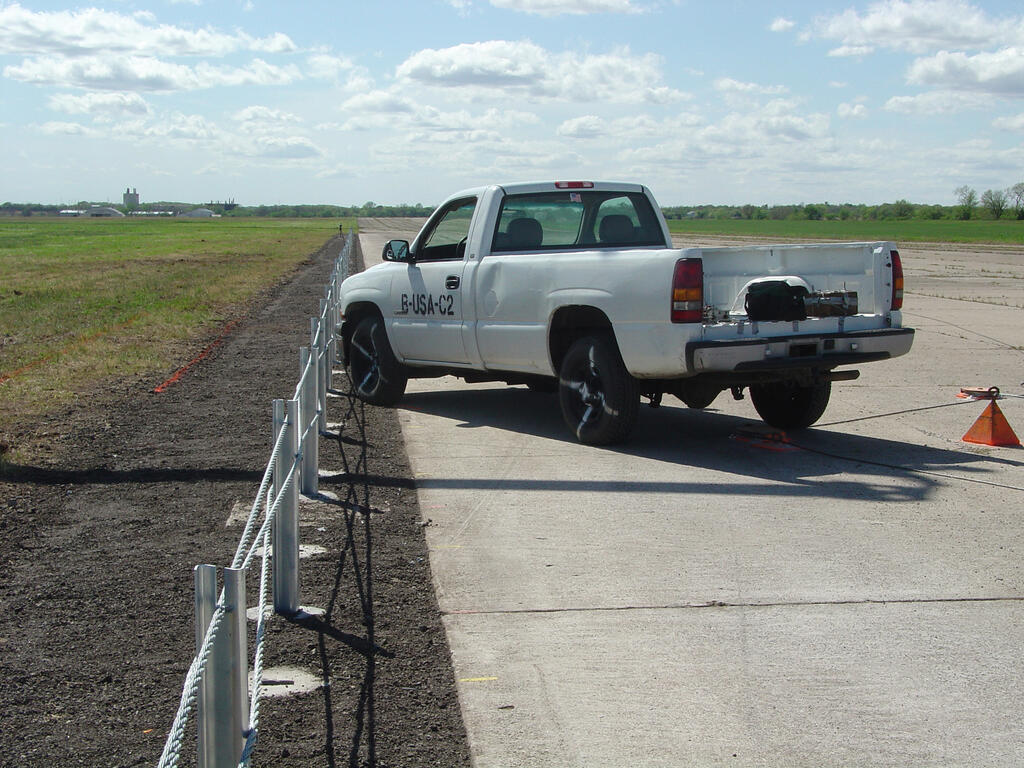
SwRI conducted full-scale testing of a pickup truck impacting a highway median cable barrier to evaluate the barrier’s performance.
AB: Yes, it is a little bit chaotic, but it's controlled chaos. We are absolutely trying to make sure that we control all the aspects of the testing, not just to make sure the testing is conducted properly but done so safely. That's one of the things that we're trying to do, is replicate dangerous scenarios or dangerous environments in a very safe manner, controlled manner.
LP: OK, so you're also testing security and perimeter barriers used in hostile vehicle mitigation. Tell us more about this area of testing.
AB: Yeah, so hostile vehicle mitigation, Southwest Research's involvement in that really kind of began shortly after our testing program, kind of back in the late — I believe it's the 1970s. There was a bombing in Beirut, Lebanon at one of the US Army barracks. A vehicle was driven past the barricades and into the barracks.
And to mitigate that, the State Department set up a series of testing and requirements for barriers to protect against that type of threat. Southwest Research was involved with developing those test methods as well as evaluating the products at the time. And then that has evolved over time to newer methods and newer standards that are used by more than just the government.
LP: When we say security and perimeter barriers, are we talking about, you go to the store and you see those sometimes they're big red balls. I think we know what store I'm talking about. Or you see just a row of short little columns in front of a store. Would that be considered a security or perimeter barrier?
AB: Yes. Those are aspects of security perimeter barriers. They're usually something like you're talking about. They refer to them as bollard. It'd be the technical term for them. So, yeah, they could be something that you're going to see at the grocery store or you're going to see at banks.
But you can also get more sophisticated systems that you can put up around a more critical security area. So Army bases, as we mentioned earlier, or around critical infrastructure to protect your electrical grid or your water systems. There are other types of fences that are used in protecting those types of features too. But the anti-vehicle barriers are also part of that.
LP: OK, so fencing and bollards is the correct term. Good to know. SwRI does test specifically fence systems for forced entry, ballistic penetration, and low-impact resistance. What type of fence systems are you testing? And what is involved in this testing process?
AB: Yeah, so the scope of those tests will really fall under one main test standard. It's an ASTM 2781 test standard. And while we have the ability to perform all the aspects of that test, really, on that test, everybody is just interested in the forced entry. So there are other tests that are better at evaluating the ballistic penetration and the low-impact resistance.
But these types of fences really can vary widely in their scope and nature, their design. You can have something that's more basic, like a chain link style fence and a kind of an upgraded chain link style fence. And you can get into something much more sophisticated that's designed to wear down tools and cutting edges to prevent aggressors from getting beyond the fence and getting into a secured area.
So the forced entry testing, what we're doing is trying to find and establish a baseline for a certain aspect or a certain set of threats. And we have a number of level threats that we're going to evaluate that fence at. So we time each of the events. And then we provide the customer with the timing that it takes to get through it with that tool set.
We actually get to see the design of the fence, the inner workings of it, so that we can assume the worst case scenario is that an aggressor has got this information. And when I say the aggressor here, it's not somebody that's driving a vehicle into it. It's almost kind of an average individual. So somebody that may be like on part of a construction crew. So the tool sets that we're looking at and using to evaluate the test are just those. So they'll include your hand saws, axes, maybe a blowtorch. Welders and things of that nature, right? So something that's common that you see in the back of the pick-up at Lowe's or Home Depot.
LP: Yeah, so the point is to make sure someone can't cut through the fence.
AB: So we're making sure that if they can cut through it, that it takes at least enough time for them to get through it that the personnel at the facility can mount a response. So you think of it you've got some infrastructure out, it's being monitored. And you have maybe guards on site, but it takes them some time to get there. It may take them 10 or 15 minutes to get there.
They can say, well, this fence is rated at 10 minutes with this type of threat, which is what we would expect. This would be an appropriate fence for us to put around our perimeter. So some of these fences may need to have a dual role. And crash testing would potentially be part of that.
So that was kind of where the low-impact resistance testing comes into play on this test standard. So with that one, we're usually going to use a bogie vehicle. We're not conducting a full-scale crash test because it is a low-impact resistance. If you do need added resistance for larger threats, vehicular threats, a lot of the ways to deal with that is to have a tiered approach. So you can have a barrier that would go in front of that that's going to stop a vehicle from actually hitting the personnel fence.
Image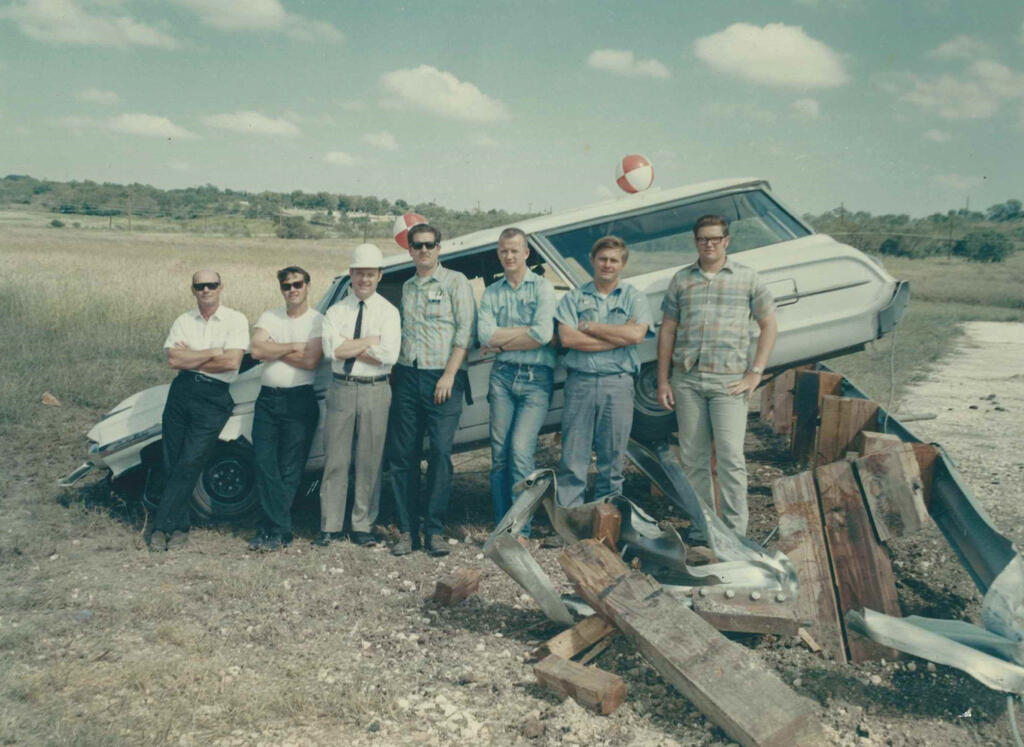
The crash crew of the late 60’s, pictured here, crash tested and researched highway safety equipment, including guardrail systems. A study titled: “The Location, Selection and Maintenance of Highway Guardrails and Median Barriers,” completed by engineers in the Department of Structural Research, was one of the earliest mentions of SwRI crash testing services. In July 1967, the Highway Research Board (HRB) requested the Institute conduct the study to provide a design and construction manual for guardrail and median barrier installations. The HRB announced publication of the study in 1969.
LP: Your testing expertise goes even further. You also conduct helmet testing. Tell us a little bit about that area.
AB: Much like the crash testing, Southwest Research has a long history dating back to the early days of the actual helmet testing programs and additionally has assisted with the development of some of the test methods. In the past few years, SwRI has played a key role in helping the US Department of Interior and the US Forestry Services to develop a test standard for evaluating commercial aviation helmets. Most test standards for aviation helmets, they really focus on combat roles.
And what the DOI and the US Forestry Service were looking at was for commercial helmets for commercial aviation roles. So think of your firefighters that are going out into remote wilderness and trying to fight the fires for both of those agencies. They don't have a need for combat role helmets. So we can provide testing on a helmet that better suits them, or better protection for that particular type of environment. So it opens up the window for more unique designs, better designs for these types of pilots. Most of the helmet testing that we do today really comes down to the motorcycle helmet testing for just your common highway use, and then also for the commercial aviation helmets that I mentioned with the DOI and the US Forestry Service.
LP: OK, so a wide range of objects, barriers, structures that you're able to test. You've served as the chief test engineer for the roadside safety hardware crash testing program, which has included fire hydrant impact testing. What qualifies as roadside hardware? And how does your process change when testing this hardware?
AB: Yeah, so pretty much anything that's going to be installed along a roadway would qualify as roadside hardware, which would include your telephone poles, sidewalks even, and then the hydrants that you mentioned. However, not all of them necessarily can be classified as safety hardware, which is what we discussed earlier with the guardrail terminals, end terminals, and crash cushions as the safety hardware aspect. The hydrants, oddly enough, we're not really testing these for the safety aspect of the hydrants. We're actually evaluating them for repair costs.
So a lot of the municipalities have a limited budget. So they need to know how much it's going to cost to repair them if they've been struck. So how much damage actually is present on the hydrant and the substructure? We impact it with the bogie vehicle and then provide the damage to it, come in, and do the rebuild.
Part of that, we are kind of checking some of the functionality of the hydrants. So unlike what you see in the movies, when a vehicle strikes a hydrant, you don't have this huge geyser of water gushing into the air. You really want it to seal off and stop. So we're also checking that aspect. So we have it tied into a water system and are watching for that. We want to make sure that it actually closes the valve up and stops the water from flowing out after the impact.
LP: Yeah. So I really wanted to talk about how you're looking at these barriers and structures for safety. Tell me a little bit about the information that you provide that helps manufacturers make these roadside structures, barriers, equipment a little safer for drivers and people sharing the roads.
AB: Yeah, so to bring up an item that everybody's probably most familiar with so the guardrails are designed out of a rail system called a W beam. And it's interesting about that. So while this is something that was done back in the early testing days of barriers, it's not any of the new testing that we do, what they were looking at on these projects was that they could provide resistance in a certain direction. But at the same time, it's the geometry in the structure of the product that provides the safety aspects.
The W beam, when you actually strike it from one direction, it'll curl up and roll away from the roadways. So it prevents it from sticking out into the road, and saving other motorists from potentially being speared or impaled on that. And you want it to get it back out of the way. You want it to also provide the safety features that they're able to provide. So you're looking at the overall behavior of the product as well.
LP: Yeah, I find that intriguing because it's not just the size or the placement, but it's also the material, or the way it behaves, as you said.
AB: Right, the way it behaves. Yeah. And you're using common materials for those too. So everything almost out there on the roadways can be made out of steel. But how can you manufacture the steel and put it into a design that provides the type of support and the safety that you need.
LP: OK can you explain that again? How does the curling feature prevent or add to safety of drivers?
AB: So as I mentioned, the W beam itself is designed to curl away from the road. If it was to curl out or to bend out into the road, it could potentially have a sharp edge or almost act like a spear, essentially. And that's a term that's used for guardrails that do penetrate into the vehicles, is spearing. So you're trying to prevent that from happening. And with a W beam design, that type of design, under most cases, will cause the barrier to deflect away and roll away from the other oncoming lanes of traffic. You want to get away from the moving vehicles.
LP: Are SwRI tests designed to protect people?
AB: Yes, absolutely. So the barriers are designed to keep vehicles on the roadway, or at least from exiting into a more severe hazard, right? You want to keep somebody from driving off of a cliff or going into a ditch. Or if they're on a bridge, you don't want them to fall off the bridge. So the barriers are designed to keep the vehicles on the roadway if it was to become errant and actually stray off and hit that barrier.
So we are looking at that type of behavior on the vehicles as well as the barriers. How do they interact? How do they behave together when we crash them? And we do that through a number of things. So we're going to have high-speed cameras, standard-speed cameras. We have multiple locations out so we can view it from all angles.
And then we were also going to instrument the vehicle itself. So we talked about making sure that the motorists are safe. We want to make sure that the acceleration levels that they're experiencing during an impact are below minimum thresholds that are designed to keep everybody safe. We want to prevent injury as well as, worst case scenario, death. We want to keep everybody safe.
LP: OK. So I imagine this type of testing gets interesting. As you described it earlier, controlled chaos. What is your most memorable behind the scenes story during crash testing?
Image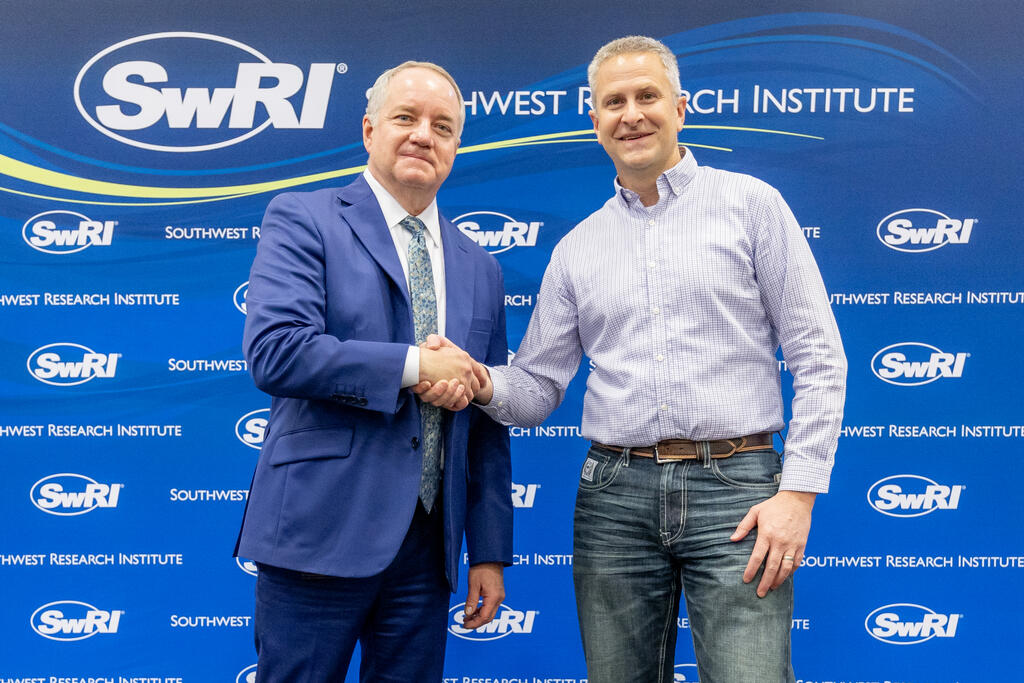
SwRI Mechanical Engineer Allen Beavers, pictured right, with SwRI President and CEO Adam Hamilton, is an expert in testing vehicle safety barriers, security fence systems and equipment designed to operate in earthquake zones. Beavers manages the helmet test program for motorcycle and commercial aviation helmets. He has also served as the chief test engineer for the roadside safety hardware crash testing program, which evaluates fire hydrants, protective bollards, security fence systems and more.
AB: Yeah so while we typically end up with a lot of cinematic footage, as you can imagine, especially when products fail. Or when we're doing the anti-vehicle barrier tests, you get the destruction of the test vehicle itself when it stops so instantly. But for me, really, I would say the most memorable really comes down to just seeing when a client comes in with a product that they've been working on for years, all the effort that they've gone into this design, all the testing that it's had to gone through and we're talking of years of testing in some cases, when they actually come to a successful product in the end, something that's going to go out onto the roadway and protect lives. That really becomes the most memorable aspect of the testing for us.
LP: Yeah, that's got to be special and definitely memorable, the whole reason why you're testing in the first place. What is the most unique item or barrier you've ever tested?
AB: Well, sadly, most of the products that I've tested or have been part of testing I'm not able to discuss. But I am aware of a mobile barrier that Southwest Research did perform testing on a few years prior to me joining the group. Some of the details on that I'm allowed to share as well here with you. And I even had an opportunity to talk with a particular client after the fact.
So this barrier was part of a trailer built into a semi truck trailer system. And the tests that they needed to perform, it was multiple tests on this particular product. Their product was also considered what you would term a restorative system. So it's designed to take multiple impacts.
And they figured, one unit is fine. They built one unit. The client literally drove the truck down to the Southwest Research test track, parked it on the edge of the track. And within a couple of days, we were able to run the two tests that it needed to be performed on it, one of them with a small car and one of them with a pickup truck, both of them traveling at 62 miles an hour.
So these vehicles crash into the barrier, deflect off, and redirect as expected. And then we collect all of our information and finish up the documentation of the testing and a few areas. After this is done, the client literally hops back into the vehicle and drives several hundred miles back home to his location. They were able to take this particular product and use it in construction zones to provide the protection for the workers there. And it had been impacted at construction sites over a dozen times and is still operating. So the resilience of it was quite amazing, right?
LP: Yeah. OK. So this was like a structure that goes behind a big truck, a trailer, to prevent an impact to the back of the trailer?
AB: So I wouldn't even really call it a big structure. It really was just a modified version of a trailer that attaches to the semi truck. So it is a mobile barrier that can come in and provide a temporary placement.
LP: OK. So definitely a unique product for you. OK, so what keeps you involved in this field of engineering? What do you enjoy about crash testing?
AB: Oh, well just in the field of engineering in general. The challenge that comes along with engineering is really fun. But when it comes to crash testing in general, really, it's just knowing that the work that we're doing is providing something meaningful to society, that we're out there saving lives and helping other groups to save lives.
LP: Amazing work you and your team are doing, Allen. We just zip by barriers and structures every day. And it's reassuring to know there are rigorous testing practices in place to make sure they are safe for our roads. So thank you for being here today and telling us about your team's important work.
AB: Well, thank you, Lisa, for having me again.
And thank you to our listeners for learning along with us today. You can hear all of our Technology Today episodes, and see photos, and complete transcripts at podcast.swri.org. Remember to share our podcast and subscribe on your favorite podcast platform.
Want to see what else we're up to? Connect with Southwest Research Institute on Facebook, Instagram, X, LinkedIn, and YouTube. Check out the Technology Today Magazine at technologytoday.swri.org. And now is a great time to become an SwRI problem solver. Visit our career page at SwRI.jobs.
Ian McKinney and Bryan Ortiz are the podcast audio engineers and editors. I am producer and host, Lisa Peña.
Thanks for listening.
[MUSIC PLAYING]
We perform vehicle crash tests on permanent and temporary roadside safety devices, including longitudinal barriers, terminals, crash cushions, support structures, work zone attenuation and channelizers. Our vehicle barrier test clients include manufacturers and end-users of roadway safety devices and barriers.
How to Listen
Listen on Apple Podcasts, or via the SoundCloud media player above.